Guru Rising: Jupiter in the Lagna Through the Twelve Signs
Why Jupiter in the Lagna deserves its own study
Of all the placements in a horoscope, Jupiter in the Lagna is the one most often greeted with a sigh of relief. The Lagna is the body and the self; Jupiter is the guru of the gods, the significator of knowledge and contentment. Varāhamihira gives Jupiter exactly these two things when he lists what each graha represents in the cosmic person: jīvo jñāna-sukhe, "Jupiter is knowledge and happiness" (Bṛhajjātaka 2.1).
The texts give three further reasons to take this placement seriously:
- Jupiter strengthens the Lagna itself. Varāhamihira says the Lagna is at its strongest when it is occupied or aspected by its own lord, by Jupiter or by Mercury, and by no others:
होरा स्वामिगुरुज्ञवीक्षितयुता नान्यैश्च वीर्योत्कटा ।
horā svāmi-guru-jña-vīkṣita-yutā nānyaiś ca vīryotkaṭā
Bṛhajjātaka 1.19 · Varāhamihira · Sanskrit text: sanskritdocuments.org · English: author’s translation
Jupiter has directional strength (dig bala) in the Lagna. The 1st house is the east, and Jupiter, with Mercury, is strongest there (details below).
Jupiter is the greatest remover of faults. Mantreśvara puts it plainly:
निःशेषदोषहरणे शुभवर्द्धने च वीर्यं गुरोरधिकमस्त्यखिलग्रहेभ्यः ।
तद्वीर्यपाददलशक्तिभृतौ ज्ञशुक्रौ चान्द्रं बलं तु निखिलग्रहवीर्यबीजम् ॥niḥśeṣa-doṣa-haraṇe śubha-varddhane ca vīryaṃ guror adhikam asty akhila-grahebhyaḥ / tad-vīrya-pāda-dala-śakti-bhṛtau jña-śukrau cāndraṃ balaṃ tu nikhila-graha-vīrya-bījam
Phaladīpikā 4.11 · Mantreśvara · Sanskrit text: sanskritdocuments.org · English: author’s translation
"In removing every fault and in increasing what is good, Jupiter's strength exceeds that of all the grahas. Mercury and Venus hold a quarter and a half of his power. But the Moon's strength is the seed of every graha's strength."
Yet anyone who has read many charts knows that Jupiter in the Lagna does not produce the same person every time. A great deal depends on which sign rises, which houses Jupiter rules for that Lagna, and how strong Jupiter actually is. This article takes those three questions in turn, and then tests them on twelve verified charts, one for each Lagna.
Translations of the verses are my own. Where the readings go beyond what the texts say, that is marked.
What the classical texts say
Varāhamihira: "learned"
Varāhamihira's chapter on the bhāvas gives Jupiter's results in all twelve houses in a single verse. The first word belongs to the Lagna:
विद्वान् सुवाक्यः कृपणः सुखी च धीमानशत्रुः पितृतोऽधिकश्च ।
नीचस्तपस्वी सधनः सलाभः खलश्च जीवे क्रमशो विलग्नात् ॥vidvān suvākyaḥ kṛpaṇaḥ sukhī ca dhīmān aśatruḥ pitṛto'dhikaś ca / nīcas tapasvī sadhanaḥ salābhaḥ khalaś ca jīve kramaśo vilagnāt
Bṛhajjātaka 20.7 · Varāhamihira · Sanskrit text: sanskritdocuments.org · English: author’s translation
"With Jupiter counted in order from the Lagna, one is: learned (1st), well-spoken (2nd), miserly (3rd), happy (4th), intelligent (5th), without enemies (6th), greater than one's father (7th), lowly (8th), an ascetic (9th), wealthy (10th), gaining (11th), wicked (12th)."
One word, vidvān, "learned", is Varāhamihira's whole verdict on Jupiter in the Lagna. It is a striking choice. He does not promise wealth or power here (those he gives to Jupiter in the 10th and 11th). He promises the quality that Jupiter himself embodies.
Mantreśvara: radiant, virtuous, long-lived, fearless
Mantreśvara expands the picture in his chapter on the bhāvas:
शोभावान् सुकृती चिरायुरभयो लग्ने गुरौ सात्मजो ।
śobhāvān sukṛtī cirāyur abhayo lagne gurau sātmajaḥ
Phaladīpikā 8.14 · Mantreśvara · Sanskrit text: sanskritdocuments.org · English: author’s translation
"With Jupiter in the Lagna, one is radiant in appearance, of good deeds, long-lived, fearless, and blessed with children."
(The online Devanagari text reads surau for gurau, an obvious misprint; Subrahmanya Sastri's edition reads Jupiter.)
Five qualities: beauty or radiance (śobhā), merit (sukṛta), long life, fearlessness and children. Each is a natural Jupiterian gift: Jupiter protects life, gives courage born of faith, and is the significator of children.
The body Jupiter gives
When a graha occupies the Lagna, astrologers traditionally read its own form into the body and bearing. The texts describe Jupiter's form clearly:
बृहत्तनुः पिङ्गलमूर्धजेक्षणो बृहस्पतिः श्रेष्ठमतिः कफात्मकः ।
bṛhat-tanuḥ piṅgala-mūrdhajekṣaṇo bṛhaspatiḥ śreṣṭha-matiḥ kaphātmakaḥ
Bṛhajjātaka 2.10 · Varāhamihira · Sanskrit text: sanskritdocuments.org · English: author’s translation
"Bṛhaspati has a large body, tawny hair and eyes, the finest intellect, and a kapha constitution."
Kalyāṇavarmā gives the fullest portrait:
ईषत्पिङ्गललोचनः श्रुतिधरः सिंहाच्छनादः स्थिरः
सत्त्वाढ्यः सुविशुद्धकाञ्चनवपुः पीनोन्नतोरःस्थलः ।
शश्वद् धर्मरतो विनीतनिपुणो बद्धोत्कटाक्षः क्षमी
स्यात्पीताम्बरभृत्कफात्मकतनुर्मेदः प्रधानो गुरुः ॥īṣat-piṅgala-locanaḥ śruti-dharaḥ siṃhāccha-nādaḥ sthiraḥ / sattvāḍhyaḥ suviśuddha-kāñcana-vapuḥ pīnonnatoraḥ-sthalaḥ / śaśvad dharma-rato vinīta-nipuṇo baddhotkaṭākṣaḥ kṣamī / syāt pītāmbara-bhṛt kaphātmaka-tanur medaḥ pradhāno guruḥ
Sārāvalī 4.25 · Kalyāṇavarmā · Sanskrit text and numbering: R. Santhanam (ed. & tr.), vol. I, Ranjan Publications · English: author’s translation
"Jupiter has slightly tawny eyes; he bears the Veda in memory; his voice is like a lion's; he is steady and rich in sattva; his body is like pure gold, with a broad, raised chest; he is ever devoted to dharma, modest and skilful, with firm, large eyes, and forbearing; he wears yellow, his constitution is kapha, and fat is his chief tissue."
Mantreśvara (Phaladīpikā 2.12) adds a golden lustre, a broad chest, and a voice deep like a lion's roar or a conch. Vaidyanātha (Jātaka Pārijāta 2.57) calls him bṛhad-udara-śarīraḥ ... sakala-guṇa-sametaḥ sarva-śāstrādhikārī: "of large belly and body, endowed with every virtue, master of all the śāstras", and sāttviko'tīva dhīmān, "sāttvic and exceedingly intelligent".
Veṅkaṭeśa states the bodily result outright: Jupiter in the Lagna, especially in a watery sign, gives a stout body (Sarvārtha Cintāmaṇi 2.224–226, quoted below).
So the classical Jupiter-rising person tends towards a large or well-filled frame, a calm and dignified presence, a resonant voice, and a mind drawn to knowledge, ethics and teaching.
Vaidyanātha: where Jupiter is strong
Vaidyanātha gives a list of the conditions in which Jupiter is strong, and two of them are surprising:
मीनालिचापकटके निजवर्गवारे मध्यन्दिनोदगयने यदि राशिमध्ये ।
कुम्भे च नीचभवनेऽपि बली सुरेज्यो लग्ने सुखे च दशमे बहुवित्तदः स्यात् ॥mīnāli-cāpa-kaṭake nija-varga-vāre madhyandinodagayane yadi rāśi-madhye / kumbhe ca nīca-bhavane'pi balī surejyo lagne sukhe ca daśame bahu-vitta-daḥ syāt
Jātaka Pārijāta 2.65 · Vaidyanātha Dīkṣita · Sanskrit text: sanskritdocuments.org · English: author’s translation
"Jupiter is strong in Pisces, Scorpio, Sagittarius and Cancer; in his own vargas and on his own weekday; at midday; in the northern course; in the middle of a sign; and in Aquarius, and even in his sign of debilitation. In the Lagna, the 4th or the 10th, he gives great wealth."
Note especially kumbhe ca nīca-bhavane'pi: in Vaidyanātha's view Jupiter keeps strength even in Aquarius and in Capricorn, his debilitation sign. Two of our example charts test exactly this.
Kalyāṇavarmā: a fine body, vitality, long life, wisdom
Kalyāṇavarmā's chapter on the grahas in the bhāvas opens Jupiter's section with the Lagna:
होरासंस्थे जीवे सुशरीरः प्राणवान् सुदीर्घायुः ।
सुसमीक्षितकार्यकरः प्राज्ञो धीरस्तथार्यश्च ॥horā-saṃsthe jīve suśarīraḥ prāṇavān sudīrghāyuḥ / susamīkṣita-kārya-karaḥ prājño dhīras tathāryaś ca
Sārāvalī 30.50 · Kalyāṇavarmā · Sanskrit text and numbering: R. Santhanam (ed. & tr.), vol. II, Ranjan Publications · English: author’s translation
"With Jupiter in the Lagna, one has a fine body, abundant vitality and a very long life; one acts only after careful consideration; and one is wise, steadfast and noble."
This is the closest of all the texts to Mantreśvara's verse (beauty and long life in both), and it adds two qualities that are easy to recognise in practice: deliberation (susamīkṣita-kārya-kara) and steadiness (dhīra).
In his notes Santhanam gathers what other authorities add. Garga gives special preference to Jupiter in the Lagna in Cancer, Sagittarius or Pisces, which he says is free from evils; elsewhere he warns of vāta and kapha disorders and false blame. Bhṛgu says that when Jupiter is in the Lagna in his debilitation sign, an enemy's sign or a malefic's sign, the native may be without children, of moderate longevity, and given to mean acts. The sign, in other words, can turn the verse upside down.
Kalyāṇavarmā gives a simpler rule for Jupiter in any kendra, of which the Lagna is the first:
चन्द्राध्यासितराशेर्नाथो लग्नाधिपोऽपि वा यस्य ।
केन्द्रे सुरपतिमन्त्री वयसो मध्ये सुखं तस्य ॥candrādhyāsita-rāśer nātho lagnādhipo'pi vā yasya / kendre surapati-mantrī vayaso madhye sukhaṃ tasya
Sārāvalī 5.18 · Kalyāṇavarmā · Sanskrit text and numbering: R. Santhanam (ed. & tr.), vol. I, Ranjan Publications · English: author’s translation
"One for whom the lord of the Moon's sign, or the lord of the Lagna, or the minister of the king of the gods (Jupiter) is in a kendra, is happy in the middle of life."
As Santhanam notes, Pṛthuyaśas in the Horāsāra requires these lords to be in a kendra with Jupiter, while Kalyāṇavarmā makes Jupiter alone in a kendra sufficient.
Veṅkaṭeśa: a full body, happiness from youth, and a long life
Veṅkaṭeśa Daivajña's Sarvārtha Cintāmaṇi treats Jupiter in the Lagna under the body and the happiness of the native. On the body:
लग्ने गुरौ तेन निरीक्षिते वा जलर्क्षगेणापि जले विलग्ने ।
सौम्यान्विते शोभनखेचरेन्द्रैः दृष्टे त्वतिस्थौल्यमुदाहरन्ति ॥lagne gurau tena nirīkṣite vā jalarkṣageṇāpi jale vilagne / saumyānvite śobhana-khecarendraiḥ dṛṣṭe tv atisthaulyam udāharanti
Sarvārtha Cintāmaṇi 2.224–226 · Veṅkaṭeśa Daivajña · Sanskrit text and numbering: B. Suryanarain Rao (ed. & tr.), 1899 · English: author’s translation
"When Jupiter is in the Lagna, or aspects it from a watery sign, or when the Lagna is a watery sign joined by benefics or aspected by the best of the benefic grahas, they declare great stoutness of body."
B. Suryanarain Rao (spelled "Row" on the 1899 title page) comments that "Guru has been specially described as a stout planet", and that Jupiter in the Lagna in a watery sign makes the person put on flesh rapidly.
On happiness, Veṅkaṭeśa says that when Jupiter is strong in a kendra from the Lagna and the Lagna lord is in Airāvatāṃśa (a high vaiśeṣikāṃśa), the native is happy from childhood, with wife, children, friends and wealth (2.236). And on longevity:
केन्द्रत्रिकोणनिधनेषु न यस्य पापा लग्नाधिपः सुरगुरुश्च चतुष्टयस्थौ ।
भुक्त्वा सुखानि विविधानि सपुण्यकर्मा जीवेच्च वत्सरशतं स विमुक्तरोगः ॥kendra-trikoṇa-nidhaneṣu na yasya pāpā lagnādhipaḥ suraguruś ca catuṣṭayasthau / bhuktvā sukhāni vividhāni sapuṇya-karmā jīvec ca vatsara-śataṃ sa vimukta-rogaḥ
Sarvārtha Cintāmaṇi 2.246 · Veṅkaṭeśa Daivajña · Sanskrit text and numbering: B. Suryanarain Rao (ed. & tr.), 1899 · English: author’s translation
"One who has no malefics in the kendras, trikoṇas or the 8th house, and whose Lagna lord and Jupiter are in kendras, enjoys many pleasures, does meritorious deeds, and lives a hundred years free from disease."
For Sagittarius and Pisces Lagnas, Jupiter in the Lagna is himself the Lagna lord in a kendra, so the second condition is fulfilled at once; the first (no malefics in kendras, trikoṇas or the 8th) is the real test.
Parāśara: the Lagna through Jupiter's lordships
Parāśara does not give a separate verse for "Jupiter in the Lagna". His method is different: he gives the result of the lord of each house when it sits in the Lagna (Bṛhat Parāśara Horā Śāstra, abbreviated below as BPHS, chapter 24, Bhāveśaphalādhyāya). Since Jupiter rules two houses for every Lagna, Parāśara's reading of Jupiter in the Lagna is the combination of two of these verses. They are given in full in the sign-by-sign section below, and summarised here:
| Lord in the Lagna | BPHS 24 | Parāśara's result (my translation) |
|---|---|---|
| 1st lord | 24.1 | Enjoys bodily happiness, strong by his own arms, high-minded, restless; two marriages or relations outside marriage |
| 2nd lord | 24.13 | Has children and wealth, but is a thorn to his own family; passionate, hard-hearted, busy with others' affairs |
| 3rd lord | 24.25 | Earns wealth by his own arms; knows how to serve; bold; intelligent even without formal learning |
| 4th lord | 24.37 | Adorned with learning and virtue; has land and vehicles; happiness from the mother |
| 5th lord | 24.49 | Learned, happy with children; but miserly, crooked-minded, takes others' wealth |
| 6th lord | 24.61 | Sickly but famous; his own enemy; wealthy, proud, daring, virtuous |
| 7th lord | 24.73 | Drawn to others' spouses; wicked yet clever; impatient; suffers from vāta |
| 8th lord | 24.85 | Deprived of bodily happiness; reviles gods and brāhmaṇas; wounds or sores |
| 9th lord | 24.97 | Fortunate, honoured by rulers, well-behaved, handsome, learned, honoured by people |
| 10th lord | 24.109 | Learned, famous, wealthy, a poet; sickly in childhood, happy later, wealth growing day by day |
| 11th lord | 24.121 | Sāttvic, wealthy, happy, impartial, a poet and eloquent, always gaining |
| 12th lord | 24.133 | A spender; weak; kapha disorders; without wealth or learning |
These verses apply to any graha ruling that house. When the graha is Jupiter, the greatest natural benefic, the harsher results are softened and the good ones strengthened. Varāhamihira, quoting Satya, gives the principle: benefics make the house they occupy grow, malefics damage it (Bṛhajjātaka 20.10, quoted below).
Two more of Parāśara's rules matter for Jupiter:
केन्द्राधिपतयः सौम्या न दिशन्ति शुभं फलम् ।
kendrādhipatayaḥ saumyā na diśanti śubhaṃ phalam
Bṛhat Parāśara Horā Śāstra 34.2 · Sanskrit text: sanskritdocuments.org edition · English: author’s translation
"Benefics that own kendras do not give good results." And in 34.10 he adds that this kendrādhipatya doṣa grows stronger in the order Moon, Mercury, Jupiter, Venus. For Gemini and Virgo Lagnas, Jupiter owns two kendras (the 7th and 10th, or the 4th and 7th), so this fault applies to him fully.
When the Lagna itself is Cancer, Sagittarius or Pisces, Jupiter rising there is in his exaltation sign (Cancer) or his own sign (Sagittarius, Pisces). He also occupies the 1st house, which is a kendra, and so Parāśara's Haṃsa yoga forms. The yoga needs both conditions together, dignity and a kendra. For a Cancer Lagna, Jupiter in his own sign Pisces stands in the 9th house, a trikoṇa, not a kendra, and does not form Haṃsa yoga. The rule:
स्वभोच्चगतकेन्द्रस्थैर्बलिभिश्च कुजादिभिः ।
क्रमशो रुचको भद्रो हंसो मालव्य एव च ॥sva-bhocca-gata-kendrasthair balibhiś ca kujādibhiḥ / kramaśo ruciko bhadro haṃso mālavya eva ca
Bṛhat Parāśara Horā Śāstra 75.1–2 · Sanskrit text: sanskritdocuments.org edition · English: author’s translation
"When Mars and the others are in a kendra in their own or exaltation sign, and strong, they form in order Ruchaka, Bhadra, Haṃsa, Mālavya [and Śaśa]."
The word balibhiḥ, "strong", is easy to overlook. Placement alone is not enough. Parāśara describes the Haṃsa native:
हंसो हंसस्वरो गौरः सुमुखोन्नतनासिकः ।
श्लेष्मलो मधुपिङ्गाक्षो रक्तवर्णनखः सुधीः ॥haṃso haṃsa-svaro gauraḥ sumukhonnata-nāsikaḥ / śleṣmalo madhu-piṅgākṣo rakta-varṇa-nakhaḥ sudhīḥ
Bṛhat Parāśara Horā Śāstra 75.13 · Sanskrit text: sanskritdocuments.org edition · English: author’s translation
"The Haṃsa native has a voice like a swan, a fair complexion, a handsome face and a prominent nose; a kapha constitution, honey-tawny eyes, red nails, and a fine mind."
The Jaimini angle: the svāṃśa as a second Lagna
In the Jaimini system the Lagna is not the only "self". The navāṃśa sign of the ātmakāraka (the kārakāṃśa or svāṃśa) is read as a second Lagna for the soul's direction. Parāśara's chapter on the kārakāṃśa, which closely parallels Jaimini's Upadeśa Sūtras 1.2, describes Jupiter there:
सर्वविद्ग्रान्थिको जीवे न वाग्मी च सभादिषु ।
शब्दज्ञश्च विशेषेण वेदवेदान्तवित् तथा ॥sarvavid grānthiko jīve na vāgmī ca sabhādiṣu / śabdajñaś ca viśeṣeṇa veda-vedānta-vit tathā
Bṛhat Parāśara Horā Śāstra 33.88 · Sanskrit text: sanskritdocuments.org edition · English: author’s translation
"With Jupiter there, one knows everything and is an author of books, though not an orator in assemblies; especially a master of words (grammar), and a knower of the Veda and Vedānta."
The verse before it (33.85–86) says that the Moon and Jupiter together in the svāṃśa or its 5th make one granthakartā sarva-vidyā-viśāradaḥ, "an author, expert in every branch of learning". So when Jupiter is in the Lagna and also in or near the kārakāṃśa, the "learned" quality is confirmed from both sides. This article stays with the rāśi Lagna, but the Jaimini check is worth making in every real chart.
What Sūrya Siddhānta contributes
The Sūrya Siddhānta is a work of astronomy, not of results. It gives no verse on Jupiter in any house. Its contribution is the one this article depends on: the computation of Jupiter's true position, his speed, and his retrograde motion. Parāśara's eight kinds of planetary motion (BPHS 27.21: cakrānuvakrā vikalā mandā mandatarā samā / carā cā'ticarā ceti grahāṇām aṣṭadhā gatiḥ), on which ceṣṭā bala (motional strength) rests, come straight from the siddhāntic model. Without the siddhānta there is no sphuṭa, and without the sphuṭa none of the strength tests below can be made.
How Jupiter's own strength changes the result
The verses above describe Jupiter in the Lagna in principle. The classical authors are equally clear that the result is delivered in proportion to the graha's strength. Seven tests matter most.
1. Dignity (sthāna bala)
Varāhamihira gives the scale:
उच्चत्रिकोणस्वसुहृच्छत्रुनीचगृहार्कगैः ।
शुभं सम्पूर्णपादोनदलपादाल्पनिष्फलम् ॥ucca-trikoṇa-sva-suhṛc-chatru-nīca-gṛhārkagaiḥ / śubhaṃ sampūrṇa-pādona-dala-pādālpa-niṣphalam
Bṛhajjātaka 20.11 · Varāhamihira · Sanskrit text: sanskritdocuments.org · English: author’s translation
"Grahas in exaltation, mūlatrikoṇa, own sign, a friend's sign and an enemy's sign give good results that are, in order, full, three-quarters, half, a quarter and slight; in debilitation, or with the Sun, nil."
Mantreśvara repeats the same scale (Phaladīpikā 4.7). For Jupiter in the Lagna this sorts the twelve Lagnas immediately:
| Lagna | Jupiter's dignity | Share of the good result (Bṛhajjātaka 20.11) |
|---|---|---|
| Cancer | Exalted (deepest at 5°) | Full |
| Sagittarius | Mūlatrikoṇa 0°–10°, own sign beyond | Three-quarters, then half |
| Pisces | Own sign | Half |
| Aries, Leo, Scorpio | Friend's sign (Mars, Sun, Mars) | A quarter |
| Aquarius | Neutral sign (Saturn) | Not in the scale; between friend and enemy |
| Taurus, Gemini, Virgo, Libra | Enemy's sign (Venus, Mercury) | Slight |
| Capricorn | Debilitated (deepest at 5°) | Nil, unless cancelled |
The natural friendship is then adjusted by the temporary relationship: the sign lord is a temporary friend if it sits in the 2nd, 3rd, 4th, 10th, 11th or 12th from Jupiter. The combination gives the compound relationship (great friend, friend, neutral, enemy, great enemy). This is shown for each example.
2. Directional strength (dig bala)
विलग्नपातालबधूनभोगा बुधामरेज्यौ भृगुसूनुचन्द्रौ ।
मन्दो धरासूनुदिवाकरौ चेत् क्रमेण ते दिग्बलशालिनः स्युः ॥vilagna-pātāla-vadhū-nabhogā budhāmarejyau bhṛgusūnu-candrau / mando dharāsūnu-divākarau cet krameṇa te digbala-śālinaḥ syuḥ
Jātaka Pārijāta 2.35 · Vaidyanātha Dīkṣita · Sanskrit text: sanskritdocuments.org · English: author’s translation
"In the Lagna, the 4th, the 7th and the 10th respectively, Mercury and Jupiter, Venus and the Moon, Saturn, and Mars and the Sun have directional strength."
Mantreśvara says the same in four words: vid-gurū lagnagau (Phaladīpikā 4.2). Kalyāṇavarmā opens his account of strength by insisting that it must be weighed before any judgment (dik-sthāna-kāla-ceṣṭā-kṛtaṃ balaṃ sarva-nirṇaya-vidhāne ... grahas tu rikto bhaved abalaḥ, "a graha without these fourfold strengths is weak", Sārāvalī 4.34), and his very next verse begins lagne jīva-budhau, "Jupiter and Mercury in the Lagna", as the first case of directional strength (Sārāvalī 4.35). Parāśara gives the method of measuring it:
सूर्यात् कुजात् सुखं जीवाज्ज्ञाच्चास्तं लग्नमार्कितः ।
दशमं च भृगोश्चन्द्राद् हित्वा षड्भाधिके सति ।
चक्राद् विशोध्य तद्भागास्त्रिभिर्भक्ताश्च दिग्बलम् ॥sūryāt kujāt sukhaṃ jīvāj jñāc cāstaṃ lagnam ārkitaḥ / daśamaṃ ca bhṛgoś candrād hitvā ṣaḍbhādhike sati / cakrād viśodhya tad-bhāgās tribhir bhaktāś ca digbalam
Bṛhat Parāśara Horā Śāstra 27.7–8 · Sanskrit text: sanskritdocuments.org edition · English: author’s translation
"From Jupiter and Mercury subtract the 7th house [for the Sun and Mars the 4th, for Saturn the Lagna, for Venus and the Moon the 10th]. If the remainder exceeds six signs, subtract it from the full circle. The degrees, divided by three, are the directional strength."
So Jupiter's dig bala is his distance from the 7th-house cusp, divided by three, out of a maximum of 60 virūpas. Jupiter anywhere in the Lagna sign has high dig bala, but it is complete only when he stands close to the rising degree itself.
3. Distance from the rising degree
Mantreśvara gives a related rule:
भावसमांशकसंस्था भावफलं पूर्णमेव कलयन्ति ।
न्यूनाधिकांशवशतः फलवृद्धिह्रसिता वाच्या ॥bhāva-samāṃśaka-saṃsthā bhāva-phalaṃ pūrṇam eva kalayanti / nyūnādhikāṃśa-vaśataḥ phala-vṛddhi-hrasitā vācyā
Phaladīpikā 8.35 · Mantreśvara · Sanskrit text: sanskritdocuments.org · English: author’s translation
"Grahas at the same degree as the bhāva give the bhāva's result in full. Where the degree is less or more, the result is to be stated as increased or reduced accordingly."
Jupiter at 2° from the Lagna degree and Jupiter at 17° from it are both "in the Lagna" by whole sign, but they do not deliver the Lagna's result equally. The examples below include both.
4. Age (bālādi avasthā)
बालः कुमारोऽथ युवा च वृद्धो मृतश्च राशावयुजि क्रमेण ।
त्रिंशल्लवैर्व्यत्ययतः समे स्युः ॥bālaḥ kumāro'tha yuvā ca vṛddho mṛtaś ca rāśāv ayuji krameṇa / triṃśal-lavair vyatyayataḥ same syuḥ
Jātaka Pārijāta 2.84 · Vaidyanātha Dīkṣita · Sanskrit text: sanskritdocuments.org · English: author’s translation
"In an odd sign, across its thirty degrees, a graha is in turn an infant, a youth, an adult, old, and dead; in an even sign the order is reversed."
Each state covers six degrees. The adult (yuvā, 12°–18°) gives the fullest result; the infant and the old give partial results; the dead (mṛta) gives very little of its own.
Kalyāṇavarmā adds a second set of nine states, based on dignity and condition rather than degree:
दीप्तः स्वस्थो मुदितः शान्तः शक्तो निपीडितो भीतः ।
विकलः खलश्च कथितो नवप्रकारो ग्रहो हरिणा ॥
स्वोच्चे भवति च दीप्तः स्वस्थः स्वगृहे सुहृद्गृहे मुदितः ।
शान्तः शुभवर्गस्थः शक्तः स्फुटकिरणजालश्च ॥dīptaḥ svastho muditaḥ śāntaḥ śakto nipīḍito bhītaḥ / vikalaḥ khalaś ca kathito nava-prakāro graho hariṇā // svocce bhavati ca dīptaḥ svasthaḥ sva-gṛhe suhṛd-gṛhe muditaḥ / śāntaḥ śubha-vargasthaḥ śaktaḥ sphuṭa-kiraṇa-jālaś ca
Sārāvalī 5.2–3 · Kalyāṇavarmā · Sanskrit text and numbering: R. Santhanam (ed. & tr.), vol. I, Ranjan Publications · English: author’s translation
"Hari has described the graha in nine states: radiant, at ease, delighted, peaceful, powerful, oppressed, frightened, crippled and wicked. In exaltation it is radiant; in its own sign, at ease; in a friend's sign, delighted; in benefic vargas, peaceful; with a clear net of rays, powerful."
The next verse completes the list: a graha whose rays are swallowed by the Sun is vikala (crippled), one defeated in planetary war is nipīḍita (oppressed), one in malefic vargas is khala (wicked), and one in debilitation is bhīta (frightened) (Sārāvalī 5.4). Verses 5.5–13 then give the result of each state. Two matter for our examples. The radiant (dīpta) graha makes one burn one's enemies with the fire of one's valour and be embraced by Lakṣmī (5.5). The crippled (vikala), that is, combust, graha makes one svasthāna-paribhraṣṭaḥ kliṣṭo malinaḥ prayāti paradeśam, "fallen from one's own place, distressed and sullied, one goes to a foreign land", one's strength broken and one's mind alarmed by enemies (5.12).
5. Retrogression
वक्रं गतो रुचिररश्मिसमूहपूर्णो नीचारिभांशसहितोऽपि भवेत्स खेटः ।
वीर्यान्वितस्तुहिनरश्मिरिवोच्चमित्रस्वक्षेत्रगोऽपि विबलो हतदीधितिश्चेत् ॥vakraṃ gato rucira-raśmi-samūha-pūrṇo nīcāri-bhāṃśa-sahito'pi bhavet sa kheṭaḥ / vīryānvitas tuhina-raśmir ivocca-mitra-svakṣetrago'pi vibalo hata-dīdhitiś cet
Phaladīpikā 4.4 · Mantreśvara · Sanskrit text: sanskritdocuments.org · English: author’s translation
"A graha in retrograde motion, full of bright rays, is to be counted strong even when it is in a debilitated or enemy sign or navāṃśa. But one whose rays are destroyed is weak, even in exaltation, a friend's sign or its own sign."
Mantreśvara goes further in his chapter on rāja yogas: yady eko'pi virājitāṃśu-nikaraḥ susthānago vakrago nīcastho'pi karoti bhūpa-sadṛśam, "even a single graha with brilliant rays, well placed and retrograde, though debilitated, makes one equal to a king" (Phaladīpikā 7.3).
There is a second, complementary view, and Kalyāṇavarmā records it:
उच्चराशौ विलोमे च फलं नाऽन्यैरिहेष्यते ।
कालस्याऽतिबहुत्वाच्च तथा स्वोच्चेऽतिवक्रिते ॥ucca-rāśau vilome ca phalaṃ nā'nyair iheṣyate / kālasyā'tibahutvāc ca tathā svocce'tivakrite
Sārāvalī 5.14 · Kalyāṇavarmā · Sanskrit text and numbering: R. Santhanam (ed. & tr.), vol. I, Ranjan Publications · English: author’s translation
"When a graha is retrograde in its exaltation sign, others do not accept that it gives good results here; nor when it has reached exaltation by retrograde motion, because of the very long time involved."
Santhanam adds in his notes that many authorities hold the converse too: a graha retrograde in its debilitation gains strength and acts favourably. This is the view of the tradition I follow: a retrograde graha gives results opposite to its dignity, so an exalted graha that is retrograde gives debilitated results, and a debilitated graha that is retrograde gives results closer to exaltation. Both views agree on the essential point: retrogression intensifies a graha and can turn a weak placement into a strong one. Five of our twelve Jupiters are retrograde.
6. Combustion
The last item in Varāhamihira's scale above is arkaga, "with the Sun", and its share of the good result is niṣphalam, "nil". Phaladīpikā 4.4 says the same of a graha whose rays are destroyed (hata-dīdhiti). Santhanam, in his notes to Sārāvalī 5.13, summarises Sarvārtha Cintāmaṇi's result for the combust state: "many sins, loss of learning, fame, wife and children". Jupiter is usually counted combust within 11° of the Sun. Two of our twelve examples have Jupiter in the Lagna but combust, and they show what that means in practice.
7. Navāṃśa: vargottama, dignity and gaṇḍānta
Varāhamihira, writing about the Moon's navāṃśa, states a principle that astrologers apply to every graha:
वर्गोत्तमस्वपरगेषु शुभं यदुक्तं तत्पुष्टमध्यलघुता ...
वीर्यान्वितोंऽशकपतिर्निरुणद्धि पूर्वं राशीक्षणस्य फलमंशफलं ददाति ॥vargottama-sva-paragesu śubhaṃ yad uktaṃ tat puṣṭa-madhya-laghutā ... vīryānvito'ṃśaka-patir niruṇaddhi pūrvaṃ rāśīkṣaṇasya phalam aṃśa-phalaṃ dadāti
Bṛhajjātaka 19.9 · Varāhamihira · Sanskrit text: sanskritdocuments.org · English: author’s translation
"The good results described are full, middling and slight when [the Moon] is in a vargottama, its own, or another's navāṃśa ... A strong navāṃśa lord overrides the result given for the sign and gives the result of the navāṃśa instead."
So a vargottama Jupiter (same sign in rāśi and navāṃśa) is firm, and Jupiter's dignity in the navāṃśa can confirm or reverse his dignity in the rāśi.
Finally, the end of the three water signs is a junction:
स्यादृक्षसन्धिः कटकालिमीनभान्तं प्रगण्डान्तमिति प्रसिद्धम् ।
syād ṛkṣa-sandhiḥ kaṭakāli-mīna-bhāntaṃ pragaṇḍāntam iti prasiddham
Jātaka Pārijāta 1.22 · Vaidyanātha Dīkṣita · Sanskrit text: sanskritdocuments.org · English: author’s translation
"The ends of Cancer, Scorpio and Pisces are the junctions of signs and nakṣatras, well known as gaṇḍānta."
A graha in the last degrees of Pisces, even in its own sign, stands at this knot.
A checklist
Putting it together, read Jupiter in the Lagna in this order:
- The sign: Jupiter's dignity (Bṛhajjātaka 20.11) and the compound relationship with the sign lord.
- The lordships: the two Parāśara verses for this Lagna (BPHS 24); kendrādhipatya doṣa for Gemini and Virgo (BPHS 34.2, 34.10); Haṃsa yoga for Cancer, Sagittarius and Pisces (BPHS 75), only if Jupiter is genuinely strong.
- Dig bala and the degree: how close Jupiter is to the rising degree (BPHS 27.7–8; Phaladīpikā 8.35).
- Avasthā: infant, youth, adult, old or dead (Jātaka Pārijāta 2.84); and Kalyāṇavarmā's nine states, from radiant to frightened (Sārāvalī 5.2–13).
- Motion and light: retrograde (Phaladīpikā 4.4, 7.3) or combust (Bṛhajjātaka 20.11, Phaladīpikā 4.4).
- Navāṃśa: vargottama, dignity in the D9, gaṇḍānta.
- Company: conjunctions and aspects on Jupiter, and cancellation of debilitation where relevant.
Jupiter in the Lagna, sign by sign
Each section below gives: Jupiter's dignity in the sign; what Kalyāṇavarmā says of Jupiter in that sign (Sārāvalī chapter 27, summarised after Santhanam's translation; these verses describe Jupiter in the sign wherever he falls, so in the Lagna they colour the whole personality); his two lordships and Parāśara's verses for them; a short reading of the personality that results (derived from the principles above, not quoted from any single text); and one example chart.
About the example charts. All twelve are calculated in the sidereal zodiac (Lahiri ayanāṃśa) with whole-sign houses, from birth data in Astro-Databank, with the Rodden rating shown (AA = birth certificate or record; A = from the person or family; B = from biography). Dig bala and ucca bala are in virūpas out of 60. "Gap" is the distance in degrees between Jupiter and the rising degree.
1. Aries (Meṣa): Jupiter in Mars's fire
Dignity. Mars is Jupiter's natural friend, so Jupiter is in a friend's sign: a quarter of the full result by Bṛhajjātaka 20.11. Aries is a movable, fiery, masculine sign.
वादिगुणैः सम्पन्नः प्रयत्नरत्नाभरणसंसर्गः ।
सत्त्वात्मजार्थबलयुक् प्रगल्भविख्यातकर्मा च ॥१॥
ओजस्वी बहुशत्रुर्बहुव्ययार्थः क्षताङ्कितशरीरः ।
चण्डोग्रदण्डनाथो जीवे क्रियगे भवेत् पुरुषः ॥२॥vādi-guṇaiḥ sampannaḥ prayatna-ratnābharaṇa-saṃsargaḥ / sattvātmajārtha-bala-yuk pragalbha-vikhyāta-karmā ca // ojasvī bahu-śatrur bahu-vyayārthaḥ kṣatāṅkita-śarīraḥ / caṇḍogra-daṇḍa-nātho jīve kriyage bhavet puruṣaḥ
Sārāvalī 27.1–2 · Kalyāṇavarmā · Sanskrit text and numbering: R. Santhanam (ed. & tr.), vol. II, Ranjan Publications · English: author’s translation
What Kalyāṇavarmā says (Sārāvalī 27.1–2). Argumentative by nature; gains gems and ornaments by his own effort; strong, with sons and wealth; an eminent and famous profession; splendid; but many enemies, heavy expenses and an injured body; deals out fierce punishments. Santhanam's note for Aries rising: corpulent, handsome, healthy, wealthy, liberal and famous.
Lordships: 9th and 12th. Parāśara on the 9th lord in the Lagna:
भाग्येशे लग्नगे जातो भाग्यवान् भूपवन्दितः ।
सुशीलश्च सुरूपश्च विद्यावान् जनपूजितः ॥bhāgyeśe lagnage jāto bhāgyavān bhūpa-vanditaḥ / suśīlaś ca surūpaś ca vidyāvān jana-pūjitaḥ
Bṛhat Parāśara Horā Śāstra 24.97 · Sanskrit text: sanskritdocuments.org edition · English: author’s translation
"Fortunate, honoured by rulers, well-behaved, handsome, learned, honoured by people."
On the 12th lord: vyayeśe lagnage jāto vyaya-śīlo bhavet (24.133), "a spender ... weak, with kapha disorders". For Aries the 9th lordship dominates: Jupiter is the dharma lord and the guru of the chart, sitting on the body.
Reading. Faith in action. The Aries Jupiter does not teach from a chair; he leads from the front. Courage (Mars) is put at the service of conviction (Jupiter), and the person is often a preacher, a reformer or a pioneer of an ideal. The 12th lordship adds sacrifice: what this person gains, he tends to give away, sometimes including himself.
Example: Martin Luther King Jr. 15 January 1929, 12:00 CST, Atlanta, Georgia (Rodden A).
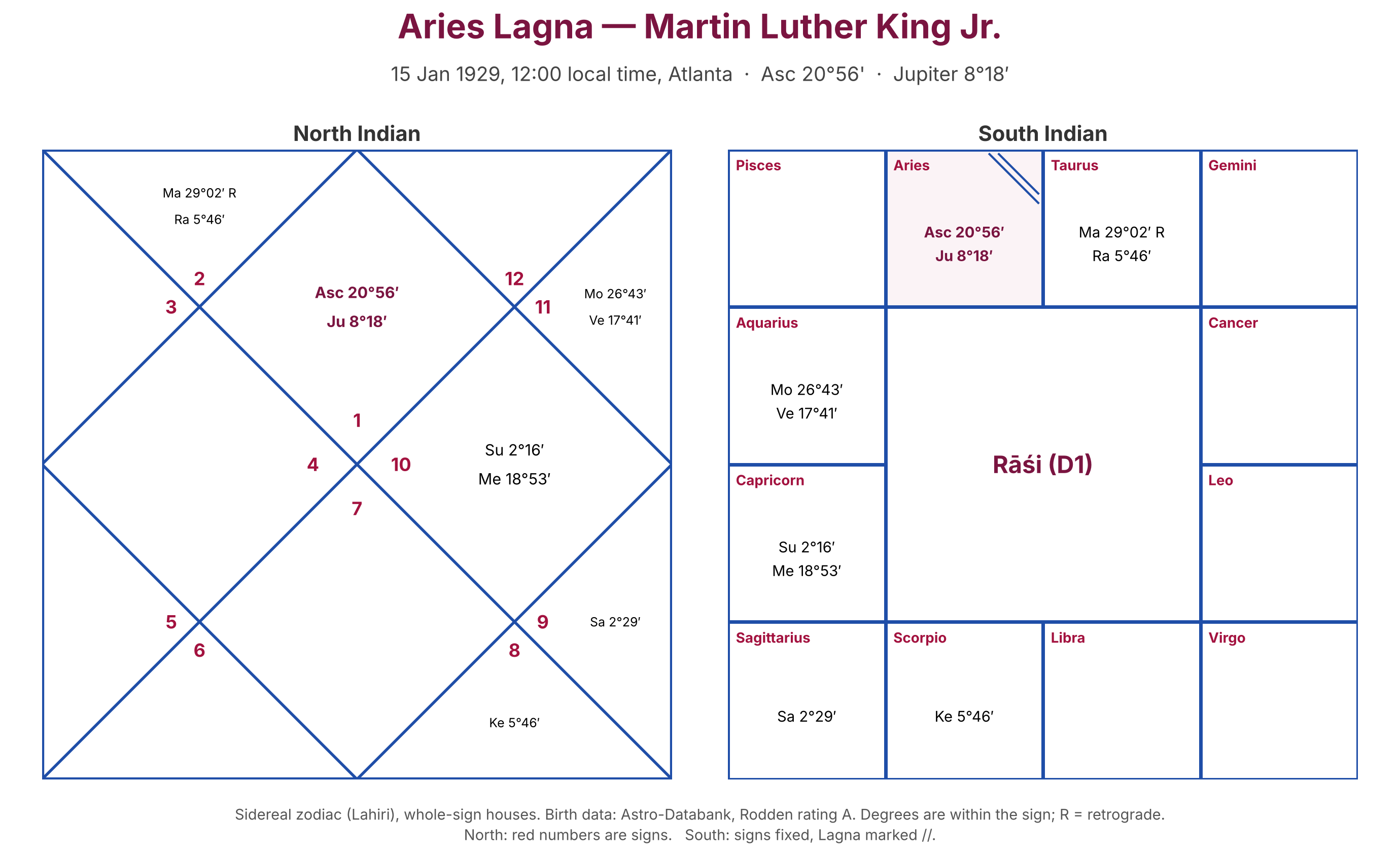
Planetary positions (sidereal, Lahiri ayanāṃśa; houses counted whole-sign from the Lagna; R = retrograde; true nodes):
| Graha | Sign | Degree | Nakṣatra (pada) | House |
|---|---|---|---|---|
| Lagna | Aries (Meṣa) | 20°56′ | Bharaṇī 3 | 1 |
| Sun (Sūrya) | Capricorn (Makara) | 2°16′ | Uttara Āṣāḍhā 2 | 10 |
| Moon (Candra) | Aquarius (Kumbha) | 26°43′ | Pūrva Bhādrapadā 3 | 11 |
| Mars (Maṅgala) | Taurus (Vṛṣabha) | 29°02′ R | Mṛgaśirā 2 | 2 |
| Mercury (Budha) | Capricorn (Makara) | 18°53′ | Śravaṇa 3 | 10 |
| Jupiter (Guru) | Aries (Meṣa) | 8°18′ | Aśvinī 3 | 1 |
| Venus (Śukra) | Aquarius (Kumbha) | 17°41′ | Śatabhiṣā 4 | 11 |
| Saturn (Śani) | Sagittarius (Dhanu) | 2°29′ | Mūla 1 | 9 |
| Rāhu | Taurus (Vṛṣabha) | 5°46′ | Kṛttikā 3 | 2 |
| Ketu | Scorpio (Vṛścika) | 5°46′ | Anurādhā 1 | 8 |
| Jupiter | Dignity | Compound relation | Dig bala | Gap | Avasthā | Navāṃśa |
|---|---|---|---|---|---|---|
| Aries 8°18′, Aśvinī | Friend's sign | Mars in Taurus, 2nd from Jupiter: great friend | 55.8 | 12.6° | Kumāra (youth) | Gemini (enemy's sign) |
Jupiter is the 9th lord in the Lagna, a clergyman's placement in a clergyman's son. His dispositor Mars, though retrograde in Taurus, is a great friend by compound relationship, which lifts Jupiter above the "quarter" of a plain friend's sign. Jupiter aspects the 9th house, where Saturn sits in Sagittarius, joining the dharma lord to the house of dharma. The weaknesses are the navāṃśa (Gemini, an enemy's sign) and a gap of 12.6° from the rising degree. A strong but not overwhelming Jupiter: the moral authority came less from Jupiter's own dignity than from his lordship and the fire of the sign. The 12th lordship (loss, sacrifice) is part of the same Jupiter.
2. Taurus (Vṛṣabha): Jupiter in Venus's sign
Dignity. Venus is Jupiter's natural enemy, the guru of the asuras: an enemy's sign, "slight" result. Taurus is fixed, earthy and feminine.
पीनो विशालदेहः सुरद्विजगवां च भक्तिमान् कान्तः ।
सुभगः स्वदारनिरतः सुवेषकृषिगोधनाढ्यश्च ॥३॥
सद्वस्तुभूषणयुतो विशिष्टवाङ्मतिगुणो नयज्ञश्च ।
वृषभे गुरौ विनीतो भिषक् प्रयोगाप्तकौशलकः ॥४॥pīno viśāla-dehaḥ sura-dvija-gavāṃ ca bhaktimān kāntaḥ / subhagaḥ sva-dāra-nirataḥ suveṣa-kṛṣi-go-dhanāḍhyaś ca // sad-vastu-bhūṣaṇa-yuto viśiṣṭa-vāṅ-mati-guṇo nayajñaś ca / vṛṣabhe gurau vinīto bhiṣak prayogāpta-kauśalakaḥ
Sārāvalī 27.3–4 · Kalyāṇavarmā · Sanskrit text and numbering: R. Santhanam (ed. & tr.), vol. II, Ranjan Publications · English: author’s translation
What Kalyāṇavarmā says (Sārāvalī 27.3–4). A broad, well-filled body; splendid and fortunate; honours brāhmaṇas and the gods; devoted to his wife and handsome; abundant wealth and cattle, fine possessions and ornaments; distinguished in speech, wise, intelligent; a political or judicial calling; skilled in medicine and experiment; modest. Santhanam notes that Venus, guru of the asuras, held the secret of reviving the dead, so Jupiter in Venus's Taurus points to the healing professions.
Lordships: 8th and 11th. This is one of the hardest pairs for Jupiter.
अष्टमेशे तनौ जातस्तनुसौख्यविवर्जितः ।
देवानां ब्राह्मणानां च निन्दको व्रणसंयुतः ॥aṣṭameśe tanau jātas tanu-saukhya-vivarjitaḥ / devānāṃ brāhmaṇānāṃ ca nindako vraṇa-saṃyutaḥ
Bṛhat Parāśara Horā Śāstra 24.85 · Sanskrit text: sanskritdocuments.org edition · English: author’s translation
"Deprived of bodily happiness; a critic of gods and brāhmaṇas; with wounds or sores."
लाभेशे लग्नगे जातः सात्त्विको धनवान् सुखी ।
समदृष्टिः कविर्वाग्मी सदा लाभसमन्वितः ॥lābheśe lagnage jātaḥ sāttviko dhanavān sukhī / sama-dṛṣṭiḥ kavir vāgmī sadā lābha-samanvitaḥ
Bṛhat Parāśara Horā Śāstra 24.121 · Sanskrit text: sanskritdocuments.org edition · English: author’s translation
"Sāttvic, wealthy and happy; impartial; a poet and eloquent; always gaining."
Reading. Taurus gives Jupiter a refined, aesthetic setting, and the 11th lordship gives gains and recognition. But the 8th lordship puts a veil over the self. The Taurus Jupiter-rising person can be admired and successful while keeping something hidden, private or withheld. The 8th is the house of secrets.
Example: Greta Garbo. 18 September 1905, 19:30 MET, Stockholm (Rodden AA).
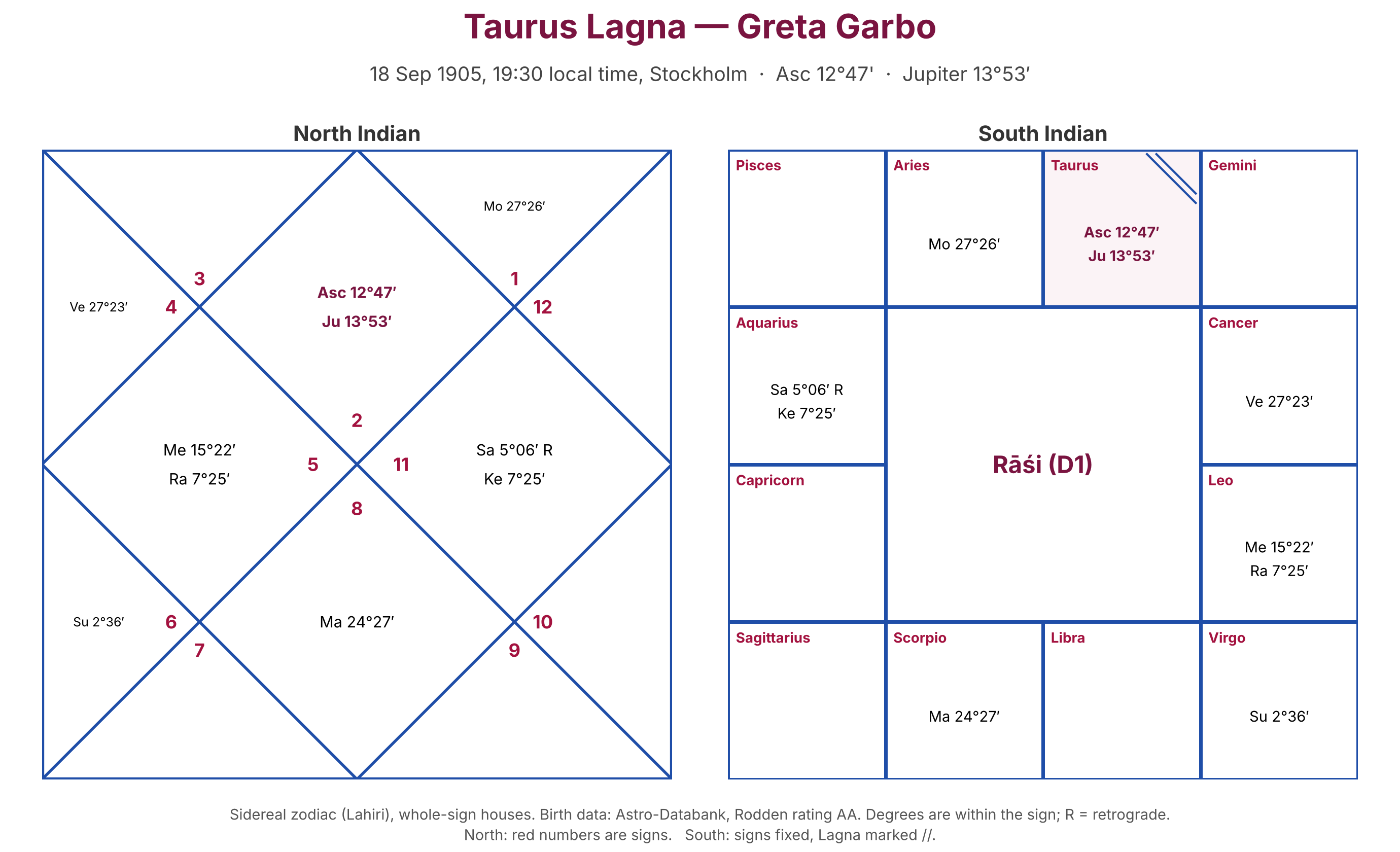
Planetary positions (sidereal, Lahiri ayanāṃśa; houses counted whole-sign from the Lagna; R = retrograde; true nodes):
| Graha | Sign | Degree | Nakṣatra (pada) | House |
|---|---|---|---|---|
| Lagna | Taurus (Vṛṣabha) | 12°47′ | Rohiṇī 1 | 1 |
| Sun (Sūrya) | Virgo (Kanyā) | 2°36′ | Uttara Phalgunī 2 | 5 |
| Moon (Candra) | Aries (Meṣa) | 27°26′ | Kṛttikā 1 | 12 |
| Mars (Maṅgala) | Scorpio (Vṛścika) | 24°27′ | Jyeṣṭhā 3 | 7 |
| Mercury (Budha) | Leo (Siṃha) | 15°22′ | Pūrva Phalgunī 1 | 4 |
| Jupiter (Guru) | Taurus (Vṛṣabha) | 13°53′ | Rohiṇī 2 | 1 |
| Venus (Śukra) | Cancer (Karka) | 27°23′ | Āśleṣā 4 | 3 |
| Saturn (Śani) | Aquarius (Kumbha) | 5°06′ R | Dhaniṣṭhā 4 | 10 |
| Rāhu | Leo (Siṃha) | 7°25′ | Maghā 3 | 4 |
| Ketu | Aquarius (Kumbha) | 7°25′ | Śatabhiṣā 1 | 10 |
| Jupiter | Dignity | Compound relation | Dig bala | Gap | Avasthā | Navāṃśa |
|---|---|---|---|---|---|---|
| Taurus 13°53′, Rohiṇī | Enemy's sign | Venus in Cancer, 3rd from Jupiter: neutral | 59.6 | 1.1° | Yuvā (adult) | Taurus: vargottama |
Here Jupiter sits almost exactly on the rising degree (1.1°), with near-full dig bala, in the adult avasthā, and vargottama. By Phaladīpikā 8.35 he gives the Lagna's results in full, and the vargottama placement makes him firm despite the enemy's sign. Mars aspects him from Scorpio. Garbo became one of the most famous screen faces in the world (11th lord on the Lagna: gains, fame, a "sāttvic" radiance on screen) and then, at the height of her career, withdrew from films and lived the rest of her long life in privacy. That is a vivid picture of the 8th lord on the body: the self that is seen everywhere and known by no one.
3. Gemini (Mithuna): Jupiter in Mercury's sign
Dignity. Mercury is Jupiter's natural enemy: an enemy's sign, "slight" result. Gemini is dual, airy and intellectual.
आहितधनः सुमेधा विज्ञानविशारदः सुनयनश्च ।
वाग्मी दाक्षिण्ययुतो निपुणः स्याद्धर्मशीलश्च ॥५॥
मान्यो गुरुबन्धूनां मण्डनमाङ्गल्यलब्धवरशब्दः ।
मिथुनस्थे देवगुरौ क्रियारतिः सत्कविश्चैव ॥६॥āhita-dhanaḥ sumedhā vijñāna-viśāradaḥ sunayanaś ca / vāgmī dākṣiṇya-yuto nipuṇaḥ syād dharma-śīlaś ca // mānyo guru-bandhūnāṃ maṇḍana-māṅgalya-labdha-vara-śabdaḥ / mithunasthe devagurau kriyā-ratiḥ satkaviś caiva
Sārāvalī 27.5–6 · Kalyāṇavarmā · Sanskrit text and numbering: R. Santhanam (ed. & tr.), vol. II, Ranjan Publications · English: author’s translation
What Kalyāṇavarmā says (Sārāvalī 27.5–6). Affluent, scholarly and proficient; attractive eyes; eloquent, courteous, skilful and virtuous; honours elders and relatives; speaks "jewelled", benevolent words; devoted to his duties; a good poet. Santhanam adds that for a Gemini Lagna, Jupiter in the Lagna itself is one of the best positions for a stable marriage, because it turns the 7th lord's influence onto the self.
Lordships: 7th and 10th. Two kendras, so Parāśara's kendrādhipatya doṣa applies in full (BPHS 34.2, 34.10).
On the 7th lord in the Lagna: dāreśe lagnage jātaḥ paradāreṣu lampaṭaḥ / duṣṭo vicakṣaṇo'dhīro jano vāta-rujānvitaḥ (24.73), "drawn to others' spouses; wicked yet clever; impatient; suffering from vāta". On the 10th lord:
कर्मेशे लग्नगे जातो विद्वान् ख्यातो धनी कविः ।
बाल्ये रोगी सुखी पश्चाद् धनवृद्धिर्दिने दिने ॥karmeśe lagnage jāto vidvān khyāto dhanī kaviḥ / bālye rogī sukhī paścād dhana-vṛddhir dine dine
Bṛhat Parāśara Horā Śāstra 24.109 · Sanskrit text: sanskritdocuments.org edition · English: author’s translation
"Learned, famous, wealthy, a poet; sickly in childhood, happy later, with wealth growing day by day."
Reading. The Gemini Jupiter thinks in words. Mercury's sign makes Jupiter's wisdom analytical, argumentative and literary rather than devotional. Public life and partnership (10th and 7th) are fused with the self: the person is known for what they think and write, and their relationships are often bound up with their work.
Example: Hannah Arendt. 14 October 1906, 21:15 MET, Hannover (Rodden AA).
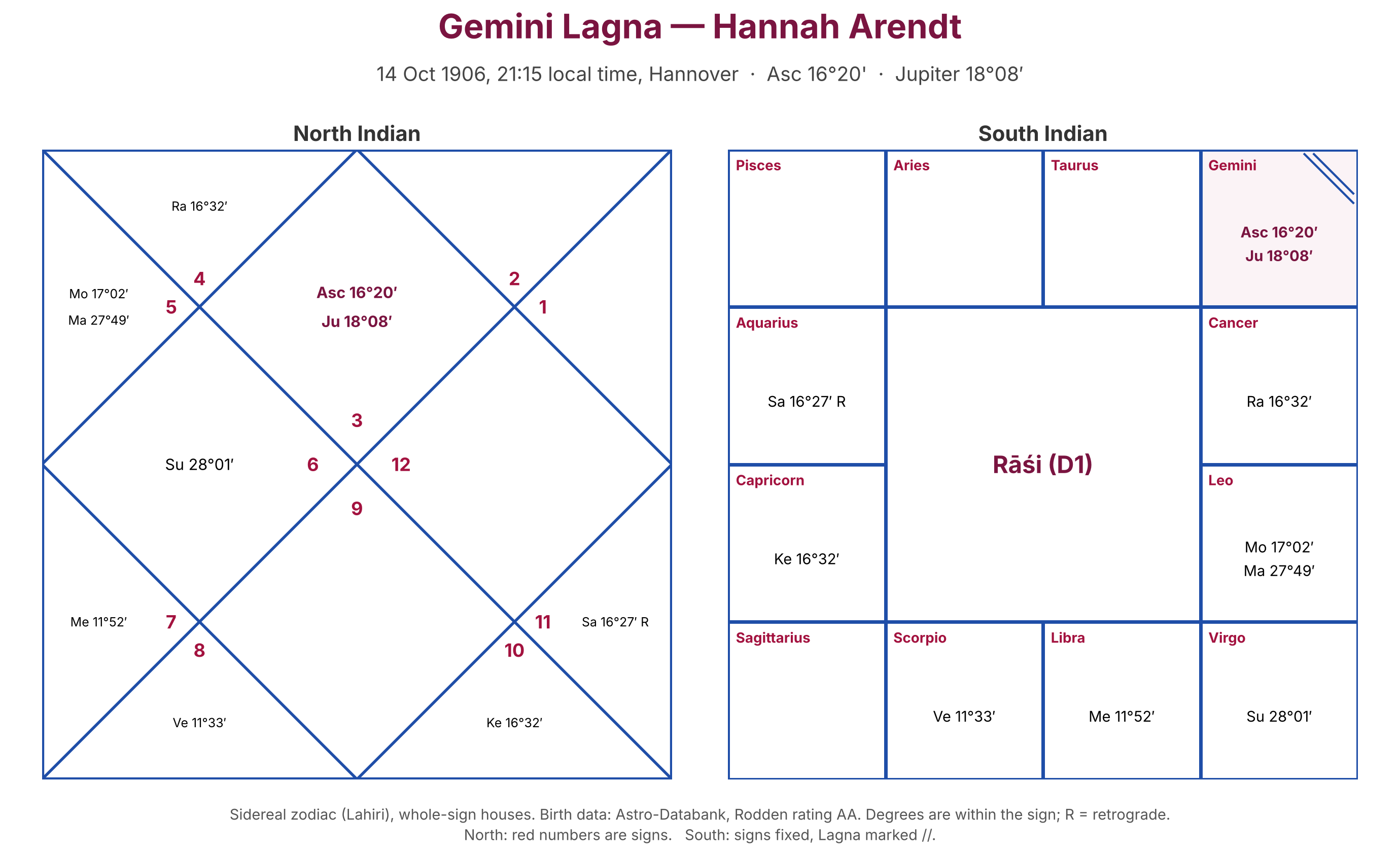
Planetary positions (sidereal, Lahiri ayanāṃśa; houses counted whole-sign from the Lagna; R = retrograde; true nodes):
| Graha | Sign | Degree | Nakṣatra (pada) | House |
|---|---|---|---|---|
| Lagna | Gemini (Mithuna) | 16°20′ | Ārdrā 3 | 1 |
| Sun (Sūrya) | Virgo (Kanyā) | 28°01′ | Citrā 2 | 4 |
| Moon (Candra) | Leo (Siṃha) | 17°02′ | Pūrva Phalgunī 2 | 3 |
| Mars (Maṅgala) | Leo (Siṃha) | 27°49′ | Uttara Phalgunī 1 | 3 |
| Mercury (Budha) | Libra (Tulā) | 11°52′ | Svātī 2 | 5 |
| Jupiter (Guru) | Gemini (Mithuna) | 18°08′ | Ārdrā 4 | 1 |
| Venus (Śukra) | Scorpio (Vṛścika) | 11°33′ | Anurādhā 3 | 6 |
| Saturn (Śani) | Aquarius (Kumbha) | 16°27′ R | Śatabhiṣā 3 | 9 |
| Rāhu | Cancer (Karka) | 16°32′ | Puṣya 4 | 2 |
| Ketu | Capricorn (Makara) | 16°32′ | Śravaṇa 2 | 8 |
| Jupiter | Dignity | Compound relation | Dig bala | Gap | Avasthā | Navāṃśa |
|---|---|---|---|---|---|---|
| Gemini 18°08′, Ārdrā | Enemy's sign | Mercury in Libra, 5th from Jupiter: great enemy | 59.4 | 1.8° | Vṛddha (old) | Pisces: own sign |
In the rāśi, Jupiter is as uncomfortable as he can be: in an enemy's sign whose lord is also a temporary enemy. But he sits within 2° of the rising degree, and in the navāṃśa he is in his own sign, Pisces. By the principle of Bṛhajjātaka 19.9, a strong navāṃśa lord can override the rāśi. Arendt became one of the most influential political philosophers of the twentieth century, "learned and famous" exactly as BPHS 24.109 says of the 10th lord in the Lagna, and her thinking was Gemini to the core: dialogue, distinction, judgment. Her personal life was famously entangled with her intellectual life (the 7th lord in the Lagna).
4. Cancer (Karka): Jupiter exalted
Dignity. Jupiter's exaltation sign, with the deepest point at 5°: the full result by Bṛhajjātaka 20.11. Jupiter is in a kendra in exaltation, so Haṃsa yoga forms, provided he is strong (BPHS 75.1).
विद्वान् सुरूपदेहः प्राज्ञः प्रियधर्मसत्स्वभावश्च ।
सुमहद्बलो यशस्वी प्रभूतधान्याकरधनेशः ॥७॥
सत्यसमाधिसुयुतः स्थिरात्मजो लोकसत्कृतः ख्यातः ।
नृपतिर्जीवे शशिभे विशिष्टकर्मा सुहृज्जनानुरतः ॥८॥vidvān surūpa-dehaḥ prājñaḥ priya-dharma-sat-svabhāvaś ca / sumahad-balo yaśasvī prabhūta-dhānyākara-dhaneśaḥ // satya-samādhi-suyutaḥ sthirātmajo loka-satkṛtaḥ khyātaḥ / nṛpatir jīve śaśibhe viśiṣṭa-karmā suhṛj-janānurataḥ
Sārāvalī 27.7–8 · Kalyāṇavarmā · Sanskrit text and numbering: R. Santhanam (ed. & tr.), vol. II, Ranjan Publications · English: author’s translation
What Kalyāṇavarmā says (Sārāvalī 27.7–8). A scholar, beautiful and highly learned; charitable and good-natured; very strong and famous; abundant grain and riches; truthful and given to tapas; long-lived sons; honoured by all; a king, with a distinguished profession and loyal to friends. Santhanam's note for Cancer rising: great merit from past lives and a mark left by spreading divine teachings; a great spiritual personage if Saturn and Ketu predominate. He adds an important caution: in the 7th navāṃśa of Cancer (from 20° to 23°20′, the Capricorn navāṃśa, where Jupiter is debilitated), "many good sides are eclipsed" and rāja yogas become defunct.
Lordships: 6th and 9th.
षष्ठेशे लग्नगे जातो रोगवान् कीर्तिसंयुतः ।
आत्मशत्रुर्धनी मानी साहसी गुणवान् नरः ॥ṣaṣṭheśe lagnage jāto rogavān kīrti-saṃyutaḥ / ātma-śatrur dhanī mānī sāhasī guṇavān naraḥ
Bṛhat Parāśara Horā Śāstra 24.61 · Sanskrit text: sanskritdocuments.org edition · English: author’s translation
"Sickly but famous; his own enemy; wealthy, proud, daring and virtuous."
The 9th lord in the Lagna (24.97) is "fortunate, honoured by rulers, learned, honoured by people".
Suryanarain Rao, commenting on Sarvārtha Cintāmaṇi, contrasts the two extremes: with Jupiter rising in Cancer the person "will be dignified, noble and jolly-tempered, while in Capricorn the person will be ordinary and mean-minded". As the Capricorn example below shows, that second half needs qualifying.
Reading. In Cancer, Jupiter's wisdom becomes nourishing and protective, like a mother's. This is the classic guru placement: the person radiates a calm, emotional depth and a sense of the sacred. The 6th lordship adds struggle and service; conflict and illness can become the field in which the dharma (9th) is fought for.
Example: Sri Aurobindo. 15 August 1872, 05:00 local time, Calcutta (Rodden B).
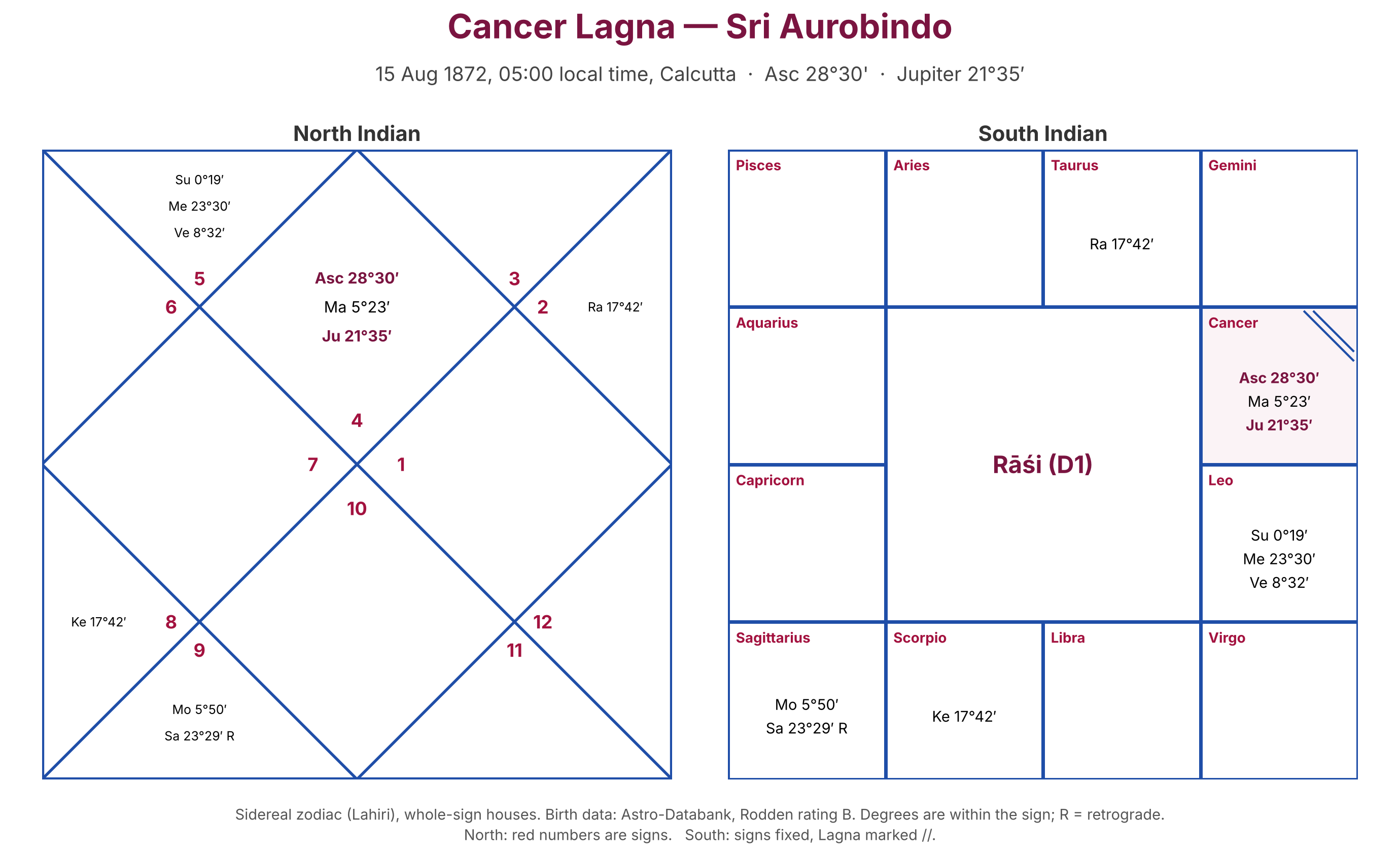
Planetary positions (sidereal, Lahiri ayanāṃśa; houses counted whole-sign from the Lagna; R = retrograde; true nodes):
| Graha | Sign | Degree | Nakṣatra (pada) | House |
|---|---|---|---|---|
| Lagna | Cancer (Karka) | 28°30′ | Āśleṣā 4 | 1 |
| Sun (Sūrya) | Leo (Siṃha) | 0°19′ | Maghā 1 | 2 |
| Moon (Candra) | Sagittarius (Dhanu) | 5°50′ | Mūla 2 | 6 |
| Mars (Maṅgala) | Cancer (Karka) | 5°23′ | Puṣya 1 | 1 |
| Mercury (Budha) | Leo (Siṃha) | 23°30′ | Pūrva Phalgunī 4 | 2 |
| Jupiter (Guru) | Cancer (Karka) | 21°35′ | Āśleṣā 2 | 1 |
| Venus (Śukra) | Leo (Siṃha) | 8°32′ | Maghā 3 | 2 |
| Saturn (Śani) | Sagittarius (Dhanu) | 23°29′ R | Pūrva Āṣāḍhā 4 | 6 |
| Rāhu | Taurus (Vṛṣabha) | 17°42′ | Rohiṇī 3 | 11 |
| Ketu | Scorpio (Vṛścika) | 17°42′ | Jyeṣṭhā 1 | 5 |
| Jupiter | Dignity | Compound relation | Dig bala | Gap | Avasthā | Navāṃśa |
|---|---|---|---|---|---|---|
| Cancer 21°35′, Āśleṣā | Exalted | — | 57.7 | 6.9° | Kumāra (youth) | Capricorn: debilitated |
This is the most instructive chart in the set. On the surface, Jupiter is exalted in the Lagna, with Haṃsa yoga. But the Sun is at 0°19′ Leo, only 8.7° away: Jupiter is combust, and by Bṛhajjātaka 20.11 and Phaladīpikā 4.4 a combust graha loses its good results even in exaltation. In the navāṃśa he falls to his debilitation sign. And debilitated Mars sits with him in Cancer (a Guru–Maṅgala combination; Mars's own debilitation is cancelled from the Moon, since Saturn, his exaltation lord, is in a kendra from the Moon).
Santhanam's caution under Sārāvalī 27.7–8 applies exactly: at 21°35′ Jupiter is in the 7th navāṃśa of Cancer, the one he says eclipses Jupiter's good results. In Kalyāṇavarmā's terms, an exalted Jupiter should be dīpta, radiant, but a combust one is vikala, crippled, and the result he gives for vikala (Sārāvalī 5.12) is "fallen from one's own place ... one goes to a foreign land", the mind alarmed by enemies. Aurobindo was a scholar and revolutionary who, after a year in prison (the 6th lord), left British India in 1910 for the French enclave of Pondicherry to escape further prosecution. There he turned from politics to yoga and spent the last four decades of his life, from 1926 largely in seclusion, writing. One way to read the combustion is that Jupiter's wisdom was absorbed into the Sun, the self, and turned inward rather than outward. This is my interpretation, not a classical rule. Caution: the data is rated B, and the Lagna is at 28°30′ Cancer. A birth a few minutes later would give a Leo Lagna, with Jupiter in the 12th.
5. Leo (Siṃha): Jupiter in the Sun's sign
Dignity. The Sun is Jupiter's natural friend: a friend's sign, a quarter of the full result. Leo is fixed, fiery and royal.
दृढवैरसत्त्वधीरः सुबहुस्नेहः सुहृज्जने विद्वान् ।
आढ्यः शिष्टाभिजनो नृपो नृपतिपौरुषः सभालक्ष्यः ॥९॥
त्रिदशगुरौ सिंहस्थे समस्तरोषोद्धृतारिपक्षश्च ।
सुदृढव्यस्तशरीरो गिरिदुर्गवनालये जातः ॥१०॥dṛḍha-vaira-sattva-dhīraḥ subahu-snehaḥ suhṛj-jane vidvān / āḍhyaḥ śiṣṭābhijano nṛpo nṛpati-pauruṣaḥ sabhā-lakṣyaḥ // tridaśa-gurau siṃhasthe samasta-roṣoddhṛtāri-pakṣaś ca / sudṛḍha-vyasta-śarīro giri-durga-vanālaye jātaḥ
Sārāvalī 27.9–10 · Kalyāṇavarmā · Sanskrit text and numbering: R. Santhanam (ed. & tr.), vol. II, Ranjan Publications · English: author’s translation
What Kalyāṇavarmā says (Sārāvalī 27.9–10). Firm in enmity, strong and steady; generous in friendship; learned and rich; eminent relatives; a king's heroism; stands out in any assembly; destroys the whole band of his enemies; a strong physique; lives among hills, forts, forests and temples. Santhanam notes that Varāhamihira gives Jupiter in Leo the same results as in exaltation, with leadership added.
Lordships: 5th and 8th. On the 5th lord in the Lagna: suteśe lagnage jāto vidvān putra-sukhānvitaḥ / kadaryo vakra-cittaś ca para-dravyāpahārakaḥ (24.49), "learned, happy with children; but miserly, crooked-minded, takes others' wealth". On the 8th lord (24.85): "deprived of bodily happiness ... wounds".
Reading. The Leo Jupiter is the king's counsellor become the king. Authority comes naturally, with a sense of duty and inheritance. The 5th lordship gives intelligence, mantra and a link to past merit; the 8th lordship brings sudden reversals, inheritance and danger to the body. Because the Sun rules the sign and is the natural ātmakāraka, the question with every Leo Jupiter is whether the Sun is close enough to burn him.
Example: Rajiv Gandhi. 20 August 1944, 06:34 local mean time, Bombay (Rodden AA).
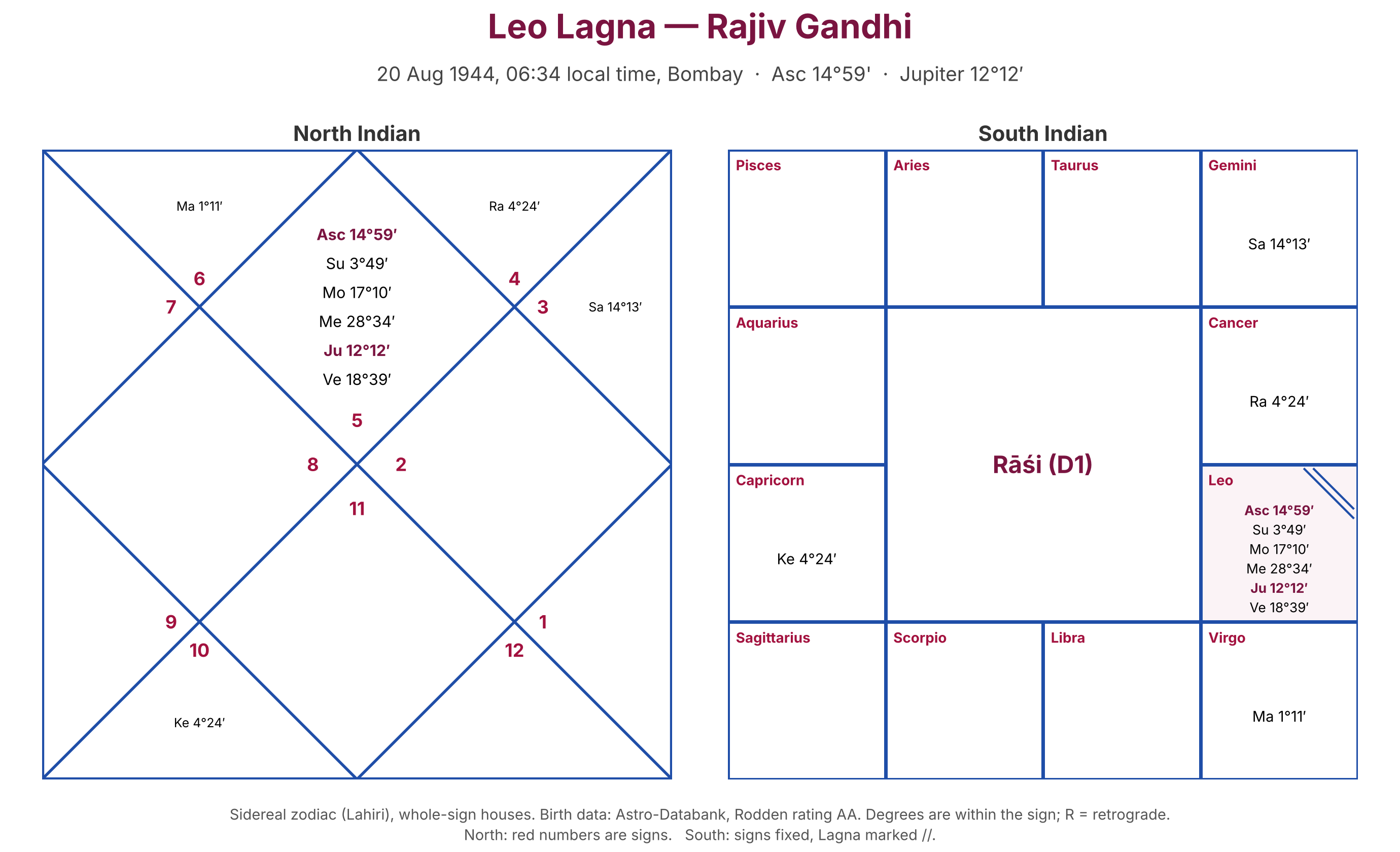
Planetary positions (sidereal, Lahiri ayanāṃśa; houses counted whole-sign from the Lagna; R = retrograde; true nodes):
| Graha | Sign | Degree | Nakṣatra (pada) | House |
|---|---|---|---|---|
| Lagna | Leo (Siṃha) | 14°59′ | Pūrva Phalgunī 1 | 1 |
| Sun (Sūrya) | Leo (Siṃha) | 3°49′ | Maghā 2 | 1 |
| Moon (Candra) | Leo (Siṃha) | 17°10′ | Pūrva Phalgunī 2 | 1 |
| Mars (Maṅgala) | Virgo (Kanyā) | 1°11′ | Uttara Phalgunī 2 | 2 |
| Mercury (Budha) | Leo (Siṃha) | 28°34′ | Uttara Phalgunī 1 | 1 |
| Jupiter (Guru) | Leo (Siṃha) | 12°12′ | Maghā 4 | 1 |
| Venus (Śukra) | Leo (Siṃha) | 18°39′ | Pūrva Phalgunī 2 | 1 |
| Saturn (Śani) | Gemini (Mithuna) | 14°13′ | Ārdrā 3 | 11 |
| Rāhu | Cancer (Karka) | 4°24′ | Puṣya 1 | 12 |
| Ketu | Capricorn (Makara) | 4°24′ | Uttara Āṣāḍhā 3 | 6 |
| Jupiter | Dignity | Compound relation | Dig bala | Gap | Avasthā | Navāṃśa |
|---|---|---|---|---|---|---|
| Leo 12°12′, Maghā | Friend's sign | Sun in Leo, same sign: neutral | 59.1 | 2.8° | Yuvā (adult) | Cancer: exalted |
Jupiter is close to the rising degree, in the adult avasthā, and exalted in the navāṃśa: on several counts a strong Jupiter. But he shares the Lagna with the Sun, Moon, Mercury and Venus, he is combust (8.4° from the Sun), and Saturn aspects the Lagna from Gemini. A five-graha Lagna is crowded, and Jupiter there is one voice among many, overshadowed by the Sun. Rajiv Gandhi, a reluctant politician who had been an airline pilot, became Prime Minister at forty after his mother's assassination, and was himself assassinated in 1991. The Jupiter that gave dignity, a gentle bearing and broad popular trust was also the 8th lord on the Lagna, under the Sun's rays and Saturn's aspect.
6. Virgo (Kanyā): Jupiter in Mercury's earth
Dignity. Mercury's sign again: an enemy's sign, "slight" result. Virgo is dual, earthy and analytical.
मेधावी धर्मपरः क्रियापटुर्धर्मवान् युवतिराशौ ।
प्रियगन्धपुष्पवस्त्रः कृत्येषु विनिश्चितार्थश्च ॥११॥
शास्त्रार्थशिल्पकार्यैर्धनवान् दाता विशुद्धशीलश्च ।
स्याद्देवगुरौ निपुणश्चित्राक्षरविद्धनसमृद्धः ॥१२॥medhāvī dharmaparaḥ kriyā-paṭur dharmavān yuvati-rāśau / priya-gandha-puṣpa-vastraḥ kṛtyeṣu viniścitārthaś ca // śāstrārtha-śilpa-kāryair dhanavān dātā viśuddha-śīlaś ca / syād devagurau nipuṇaś citrākṣara-vid dhana-samṛddhaḥ
Sārāvalī 27.11–12 · Kalyāṇavarmā · Sanskrit text and numbering: R. Santhanam (ed. & tr.), vol. II, Ranjan Publications · English: author’s translation
What Kalyāṇavarmā says (Sārāvalī 27.11–12). A scholar, virtuous and skilful in his work; fond of scents, fine clothes and flowers; firm in his undertakings; experienced in the śāstras and the fine arts; affluent, charitable, pure-hearted, and "wonderfully learned". Santhanam calls it a mark of the educationist, less favourable for wealth.
Lordships: 4th and 7th. Two kendras: kendrādhipatya doṣa applies (BPHS 34.2, 34.10).
सुखेशे लग्नगे जातो विद्यागुणविभूषितः ।
भूमीवाहनसंयुक्तो मातुः सुखसमन्वितः ॥sukheśe lagnage jāto vidyā-guṇa-vibhūṣitaḥ / bhūmī-vāhana-saṃyukto mātuḥ sukha-samanvitaḥ
Bṛhat Parāśara Horā Śāstra 24.37 · Sanskrit text: sanskritdocuments.org edition · English: author’s translation
"Adorned with learning and good qualities; possesses land and vehicles; enjoys happiness from the mother."
The 7th lord in the Lagna (24.73) is as in Gemini above.
Reading. In Virgo, Jupiter's broad vision is pressed into detail, method and service. The person is a thinker who wants proof, or a believer who keeps searching. Because Mercury and Jupiter are each other's sign-lords in this sign and in Pisces, look at once for an exchange (parivartana) between them.
Example: Shirley MacLaine. 24 April 1934, 15:57 EST, Richmond, Virginia (Rodden AA).
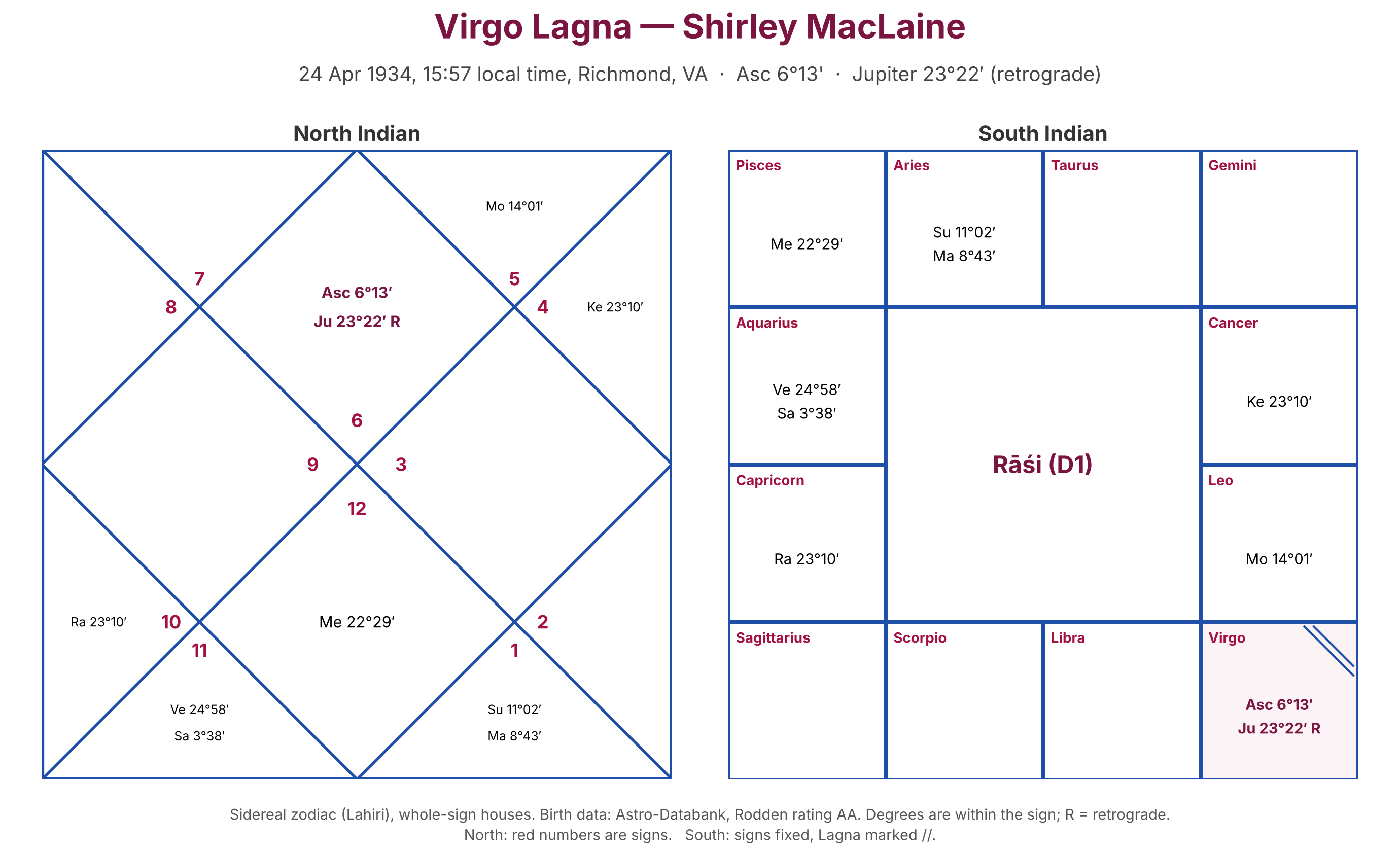
Planetary positions (sidereal, Lahiri ayanāṃśa; houses counted whole-sign from the Lagna; R = retrograde; true nodes):
| Graha | Sign | Degree | Nakṣatra (pada) | House |
|---|---|---|---|---|
| Lagna | Virgo (Kanyā) | 6°13′ | Uttara Phalgunī 3 | 1 |
| Sun (Sūrya) | Aries (Meṣa) | 11°02′ | Aśvinī 4 | 8 |
| Moon (Candra) | Leo (Siṃha) | 14°01′ | Pūrva Phalgunī 1 | 12 |
| Mars (Maṅgala) | Aries (Meṣa) | 8°43′ | Aśvinī 3 | 8 |
| Mercury (Budha) | Pisces (Mīna) | 22°29′ | Revatī 2 | 7 |
| Jupiter (Guru) | Virgo (Kanyā) | 23°22′ R | Citrā 1 | 1 |
| Venus (Śukra) | Aquarius (Kumbha) | 24°58′ | Pūrva Bhādrapadā 2 | 6 |
| Saturn (Śani) | Aquarius (Kumbha) | 3°38′ | Dhaniṣṭhā 4 | 6 |
| Rāhu | Capricorn (Makara) | 23°10′ | Śravaṇa 4 | 5 |
| Ketu | Cancer (Karka) | 23°10′ | Āśleṣā 2 | 11 |
| Jupiter | Dignity | Compound relation | Dig bala | Gap | Avasthā | Navāṃśa |
|---|---|---|---|---|---|---|
| Virgo 23°22′ R, Citrā | Enemy's sign | Mercury in Pisces, 7th from Jupiter: great enemy | 54.3 | 17.1° | Kumāra (youth) | Leo (friend's sign) |
Jupiter is far from the rising degree (17°) and in an enemy's sign, two reasons for a reduced result (Phaladīpikā 8.35, Bṛhajjātaka 20.11). But he is retrograde, which Mantreśvara counts as strength in an enemy's sign (Phaladīpikā 4.4), and he is in exchange with Mercury: Jupiter in Mercury's Virgo, Mercury in Jupiter's Pisces (where Mercury is debilitated). The exchange ties the Lagna to the 7th house and Jupiter's sign. MacLaine, a celebrated actress and dancer, became in mid-life one of the best-known writers on reincarnation and spiritual experience. A retrograde Jupiter in the Lagna, in exchange with Mercury, the planet of writing, fits a person who turned a sceptical Virgo mind towards metaphysics, publicly and unconventionally.
7. Libra (Tulā): Jupiter in Venus's air
Dignity. Venus's sign: an enemy's sign, "slight" result. Libra is movable, airy, the sign of balance and exchange.
मेधावी बहुपुत्रो विदेशचर्यागतः प्रभूतधनः ।
भूषाप्रियो विनीतो नटनर्तकसंगृहीतधनः ॥१३॥
कान्तः श्रुताभिनिरतो महत्तरः सार्थवाहवणिजां हि ।
वणिजीन्द्रमन्त्रिणि गते सुरातिथीज्यारतः प्राज्ञः ॥१४॥medhāvī bahu-putro videśa-caryā-gataḥ prabhūta-dhanaḥ / bhūṣā-priyo vinīto naṭa-nartaka-saṃgṛhīta-dhanaḥ // kāntaḥ śrutābhinirato mahattaraḥ sārthavāha-vaṇijāṃ hi / vaṇijīndra-mantriṇi gate surātithījyā-rataḥ prājñaḥ
Sārāvalī 27.13–14 · Kalyāṇavarmā · Sanskrit text and numbering: R. Santhanam (ed. & tr.), vol. II, Ranjan Publications · English: author’s translation
What Kalyāṇavarmā says (Sārāvalī 27.13–14). A scholar with many sons; work in foreign lands; very affluent and fond of ornaments; modest; earns through dance and drama; pleasing and splendid in appearance; learned in the śāstras; foremost among his fellows; honours gods and guests.
Lordships: 3rd and 6th. Both are malefic lordships in Parāśara's scheme (tri-ṣaḍ-āyādhipāḥ sarve grahāḥ pāpa-phalāḥ smṛtāḥ, BPHS 34.4). On the 3rd lord in the Lagna: lagnage sahajādhīśe svabhujārjita-vittavān / sevājñaḥ sāhasī jāto vidyāhīno'pi buddhimān (24.25), "earns by his own arms; knows how to serve; bold; intelligent even without formal learning". On the 6th lord (24.61): "sickly but famous; his own enemy; wealthy, proud, daring, virtuous".
Reading. For Libra, Jupiter is a functional malefic: the guru who brings effort, service, illness and conflict to the self. Yet he is still Jupiter. The result is often a person whose suffering becomes their teaching, or whose service is their spirituality.
Example: Padre Pio (Pio of Pietrelcina). 25 May 1887, 17:00 local standard time (Rome meridian), Pietrelcina, Italy (Rodden AA).
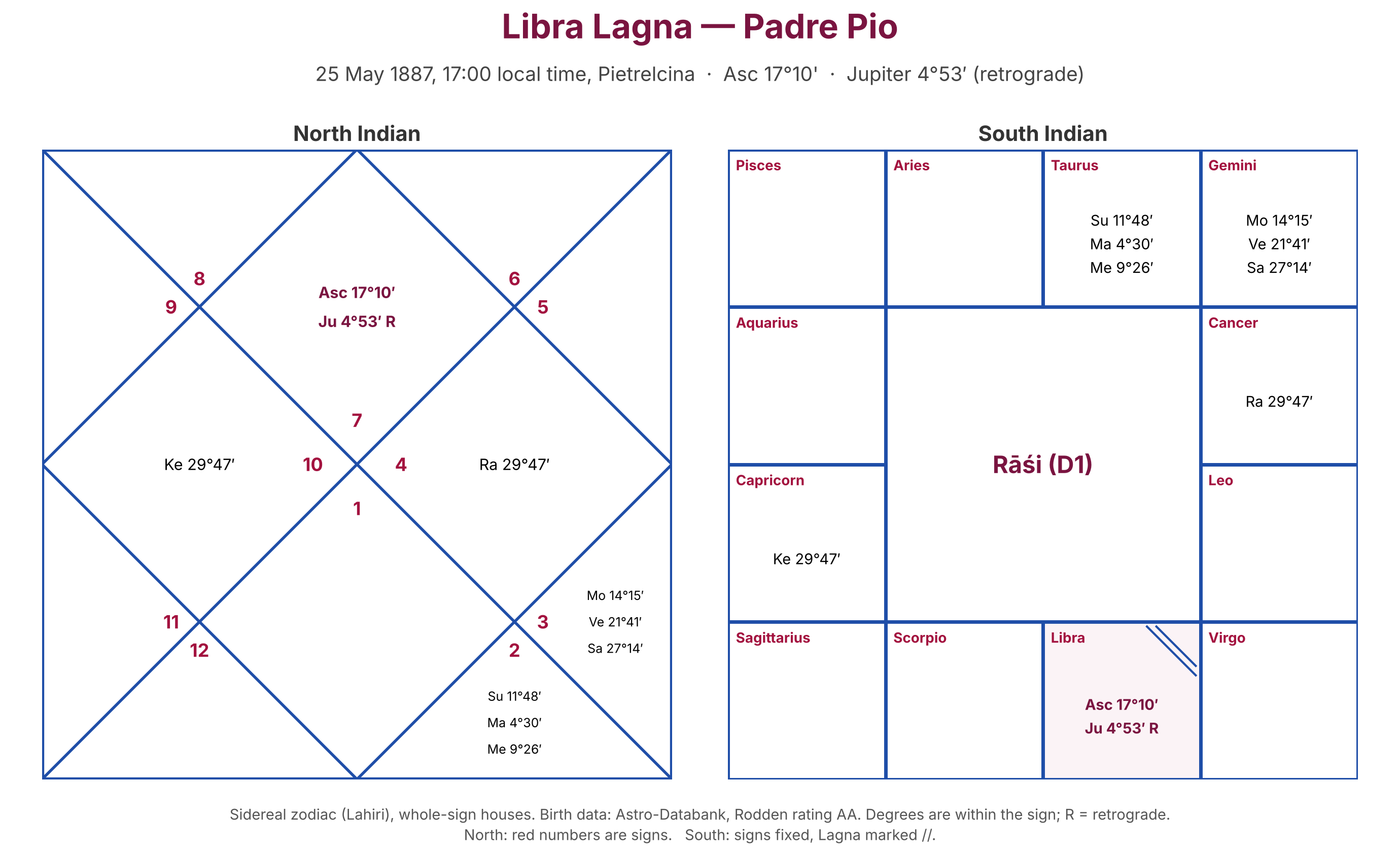
Planetary positions (sidereal, Lahiri ayanāṃśa; houses counted whole-sign from the Lagna; R = retrograde; true nodes):
| Graha | Sign | Degree | Nakṣatra (pada) | House |
|---|---|---|---|---|
| Lagna | Libra (Tulā) | 17°10′ | Svātī 4 | 1 |
| Sun (Sūrya) | Taurus (Vṛṣabha) | 11°48′ | Rohiṇī 1 | 8 |
| Moon (Candra) | Gemini (Mithuna) | 14°15′ | Ārdrā 3 | 9 |
| Mars (Maṅgala) | Taurus (Vṛṣabha) | 4°30′ | Kṛttikā 3 | 8 |
| Mercury (Budha) | Taurus (Vṛṣabha) | 9°26′ | Kṛttikā 4 | 8 |
| Jupiter (Guru) | Libra (Tulā) | 4°53′ R | Citrā 4 | 1 |
| Venus (Śukra) | Gemini (Mithuna) | 21°41′ | Punarvasu 1 | 9 |
| Saturn (Śani) | Gemini (Mithuna) | 27°14′ | Punarvasu 3 | 9 |
| Rāhu | Cancer (Karka) | 29°47′ | Āśleṣā 4 | 10 |
| Ketu | Capricorn (Makara) | 29°47′ | Dhaniṣṭhā 2 | 4 |
| Jupiter | Dignity | Compound relation | Dig bala | Gap | Avasthā | Navāṃśa |
|---|---|---|---|---|---|---|
| Libra 4°53′ R, Citrā | Enemy's sign | Venus in Gemini, 9th from Jupiter: great enemy | 55.9 | 12.3° | Bāla (infant) | Scorpio (friend's sign) |
By sign, Jupiter is weak: an enemy's sign, a great-enemy dispositor, the infant avasthā. But he is retrograde, which by Phaladīpikā 4.4 restores strength in an enemy's sign. Parāśara's verse for the 6th lord in the Lagna, rogavān kīrti-saṃyutaḥ, "sickly but famous", reads like a summary of this life. The Capuchin friar bore the stigmata for fifty years, suffered illness throughout his life, became a figure of mass devotion in his lifetime, and was canonised in 2002. Jupiter's dharma here was lived through the body's suffering, as Libra's 6th lordship suggests.
8. Scorpio (Vṛścika): Jupiter in Mars's water
Dignity. Mars's sign: a friend's sign, a quarter of the full result. Vaidyanātha lists Scorpio among Jupiter's signs of strength (mīnāli-cāpa-kaṭake, Jātaka Pārijāta 2.65). Scorpio is fixed, watery and secret.
बहुशास्त्राणां कुशलो नृपतिर्बहुभाष्यकारको निपुणः ।
देवालयपुरकर्ता सद्बहुदारोऽल्पपुत्रश्च ॥१५॥
व्याध्यार्तः श्रमबहुलः प्रसक्तरोषो गुरौ भवत्यलिनि ।
दम्भेन धर्मनिरतो जुगुप्सिताचारनिरतश्च ॥१६॥bahu-śāstrāṇāṃ kuśalo nṛpatir bahu-bhāṣya-kārako nipuṇaḥ / devālaya-pura-kartā sad-bahu-dāro'lpa-putraś ca // vyādhyārtaḥ śrama-bahulaḥ prasakta-roṣo gurau bhavaty alini / dambhena dharma-nirato jugupsitācāra-nirataś ca
Sārāvalī 27.15–16 · Kalyāṇavarmā · Sanskrit text and numbering: R. Santhanam (ed. & tr.), vol. II, Ranjan Publications · English: author’s translation
What Kalyāṇavarmā says (Sārāvalī 27.15–16). Expert in the śāstras; a ruler; a commentator on many texts; skilful; a builder of temples and towns; many wives but few sons; troubled by disease and many difficulties; quick to anger; devoted to dharma, but with ostentation (dambhena), and given to contemptible conduct. Santhanam calls these mixed results. His note for Scorpio rising: excellent results for children, spouse and family, with some health troubles.
Lordships: 2nd and 5th.
धनेशे लग्नगे जातः पुत्रवान् धनसंयुतः ।
कुटुम्बकण्टकः कामी निष्ठुरः परकार्यकृत् ॥dhaneśe lagnage jātaḥ putravān dhana-saṃyutaḥ / kuṭumba-kaṇṭakaḥ kāmī niṣṭhuraḥ para-kārya-kṛt
Bṛhat Parāśara Horā Śāstra 24.13 · Sanskrit text: sanskritdocuments.org edition · English: author’s translation
"Has children and wealth; but a thorn to his own family; passionate, hard-hearted, busy with others' affairs."
The 5th lord in the Lagna (24.49): "learned, happy with children ..."
Reading. In Scorpio, Jupiter goes deep: into mystery, psychology, the hidden and the transformative. The 2nd (speech, family, stories) and 5th (creativity, children, mantra) lordships make the Scorpio Jupiter a natural storyteller or teacher whose words carry the weight of experience, often of pain transformed.
Example: Hans Christian Andersen. 2 April 1805, 01:00 local mean time, Odense, Denmark (Rodden AA).
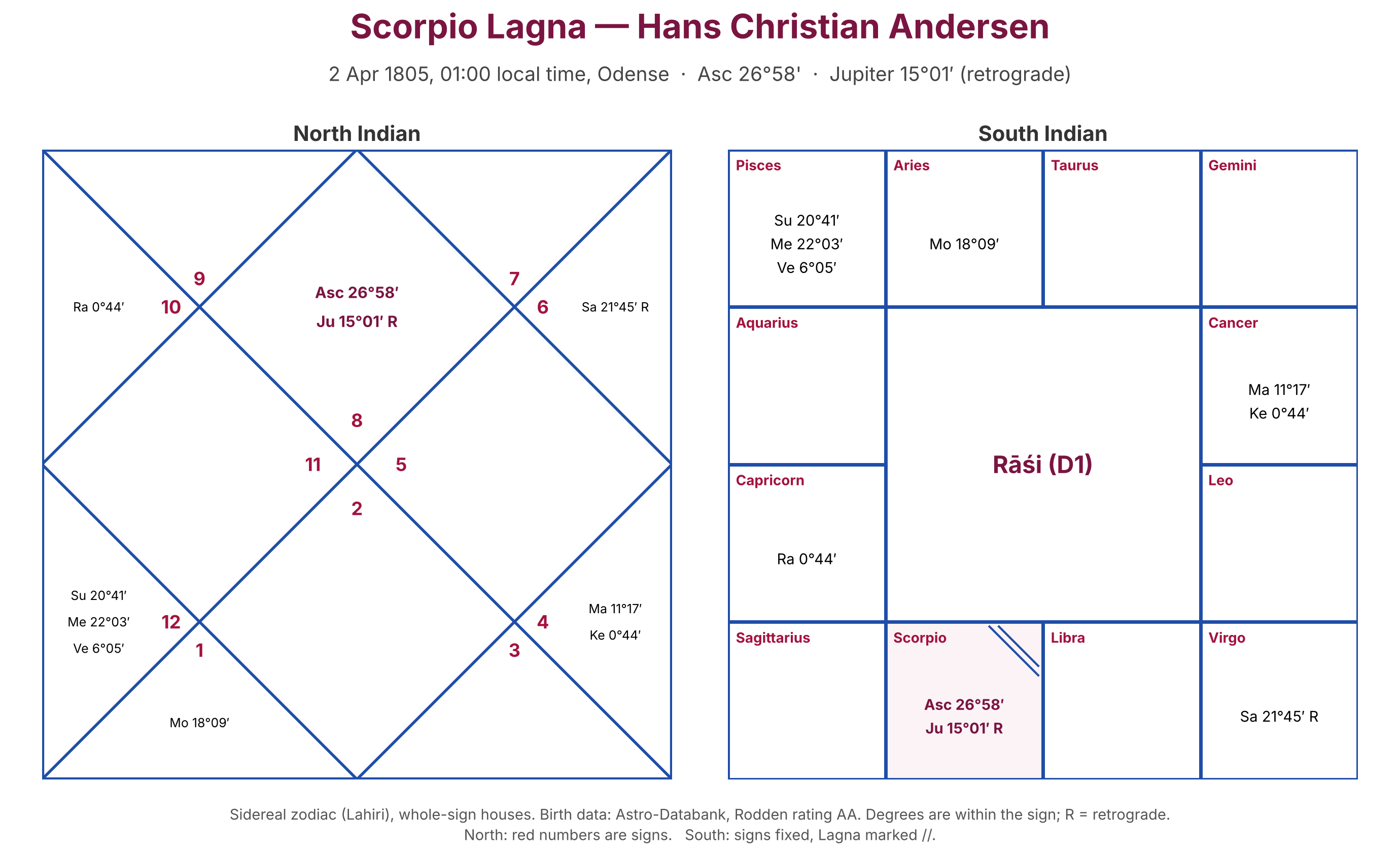
Planetary positions (sidereal, Lahiri ayanāṃśa; houses counted whole-sign from the Lagna; R = retrograde; true nodes):
| Graha | Sign | Degree | Nakṣatra (pada) | House |
|---|---|---|---|---|
| Lagna | Scorpio (Vṛścika) | 26°58′ | Jyeṣṭhā 4 | 1 |
| Sun (Sūrya) | Pisces (Mīna) | 20°41′ | Revatī 2 | 5 |
| Moon (Candra) | Aries (Meṣa) | 18°09′ | Bharaṇī 2 | 6 |
| Mars (Maṅgala) | Cancer (Karka) | 11°17′ | Puṣya 3 | 9 |
| Mercury (Budha) | Pisces (Mīna) | 22°03′ | Revatī 2 | 5 |
| Jupiter (Guru) | Scorpio (Vṛścika) | 15°01′ R | Anurādhā 4 | 1 |
| Venus (Śukra) | Pisces (Mīna) | 6°05′ | Uttara Bhādrapadā 1 | 5 |
| Saturn (Śani) | Virgo (Kanyā) | 21°45′ R | Hasta 4 | 11 |
| Rāhu | Capricorn (Makara) | 0°44′ | Uttara Āṣāḍhā 2 | 3 |
| Ketu | Cancer (Karka) | 0°44′ | Punarvasu 4 | 9 |
| Jupiter | Dignity | Compound relation | Dig bala | Gap | Avasthā | Navāṃśa |
|---|---|---|---|---|---|---|
| Scorpio 15°01′ R, Anurādhā | Friend's sign | Mars in Cancer, 9th from Jupiter: neutral | 56.0 | 11.9° | Yuvā (adult) | Scorpio: vargottama |
Jupiter is retrograde, vargottama, and in the adult avasthā: three marks of strength. Saturn aspects him from Virgo. As lord of the 2nd (speech, stories) and the 5th (creativity, and children) on the Lagna, he produced one of the most famous storytellers who ever lived: a poor cobbler's son from Odense who became world-famous for tales read to children everywhere. Many of those tales (The Ugly Duckling, The Little Mermaid) carry Scorpio's themes of pain, longing and transformation.
9. Sagittarius (Dhanus): Jupiter at home
Dignity. Jupiter's own sign, with mūlatrikoṇa in the first 10° (three-quarters of the full result) and own sign beyond (half). Haṃsa yoga forms, if Jupiter is strong (BPHS 75.1).
आचार्यो व्रतदीक्षायज्ञादीनां स्थिरार्थश्च ।
दाता सुहृत्स्वपक्षः परोपकारश्रुताभिरतः ॥१७॥
माण्डलिको मन्त्री वा धनुर्धरस्थे भवेत् सदा जीवे ।
नानादेशनिवासी विविक्ततीर्थायतनबुद्धिः ॥१८॥ācāryo vrata-dīkṣā-yajñādīnāṃ sthirārthaś ca / dātā suhṛt-sva-pakṣaḥ paropakāra-śrutābhirataḥ // māṇḍaliko mantrī vā dhanurdharasthe bhavet sadā jīve / nānā-deśa-nivāsī vivikta-tīrthāyatana-buddhiḥ
Sārāvalī 27.17–18 · Kalyāṇavarmā · Sanskrit text and numbering: R. Santhanam (ed. & tr.), vol. II, Ranjan Publications · English: author’s translation
What Kalyāṇavarmā says (Sārāvalī 27.17–18). A preceptor; conducts vows, initiations and sacrifices; lasting wealth; charitable and kind to his own people; fond of helping others and of the śāstras; head of a region or a minister; lives in many countries; prefers solitude and pilgrimage. Santhanam's note for Sagittarius rising: "a native with divine grace", while recording one school's view (echoing BPHS 24.1) of a second marriage.
Lordships: 1st and 4th.
लग्नेशे लग्नगे देहसुखभाग् भुजविक्रमी ।
मनस्वी चञ्चलश्चैव द्विभार्यो परगोऽपि वा ॥lagneśe lagnage deha-sukha-bhāg bhuja-vikramī / manasvī cañcalaś caiva dvibhāryo parago'pi vā
Bṛhat Parāśara Horā Śāstra 24.1 · Sanskrit text: sanskritdocuments.org edition · English: author’s translation
"The Lagna lord in the Lagna: enjoys bodily happiness, is strong by his own arms, high-minded and restless; may have two wives or go to others."
The 4th lord in the Lagna (24.37): "adorned with learning and good qualities ...".
Reading. Here Jupiter is fully himself: the Lagna lord on the Lagna, in his own sign. The person is visibly a seeker, teacher, preacher or judge, with a strong conscience and a sense of mission. But "own sign" alone does not settle the question. The degree, the avasthā and the aspects decide how much of that mission can be lived in peace.
Example: Malcolm X. 19 May 1925, 22:25 CST, Omaha, Nebraska (Rodden AA).
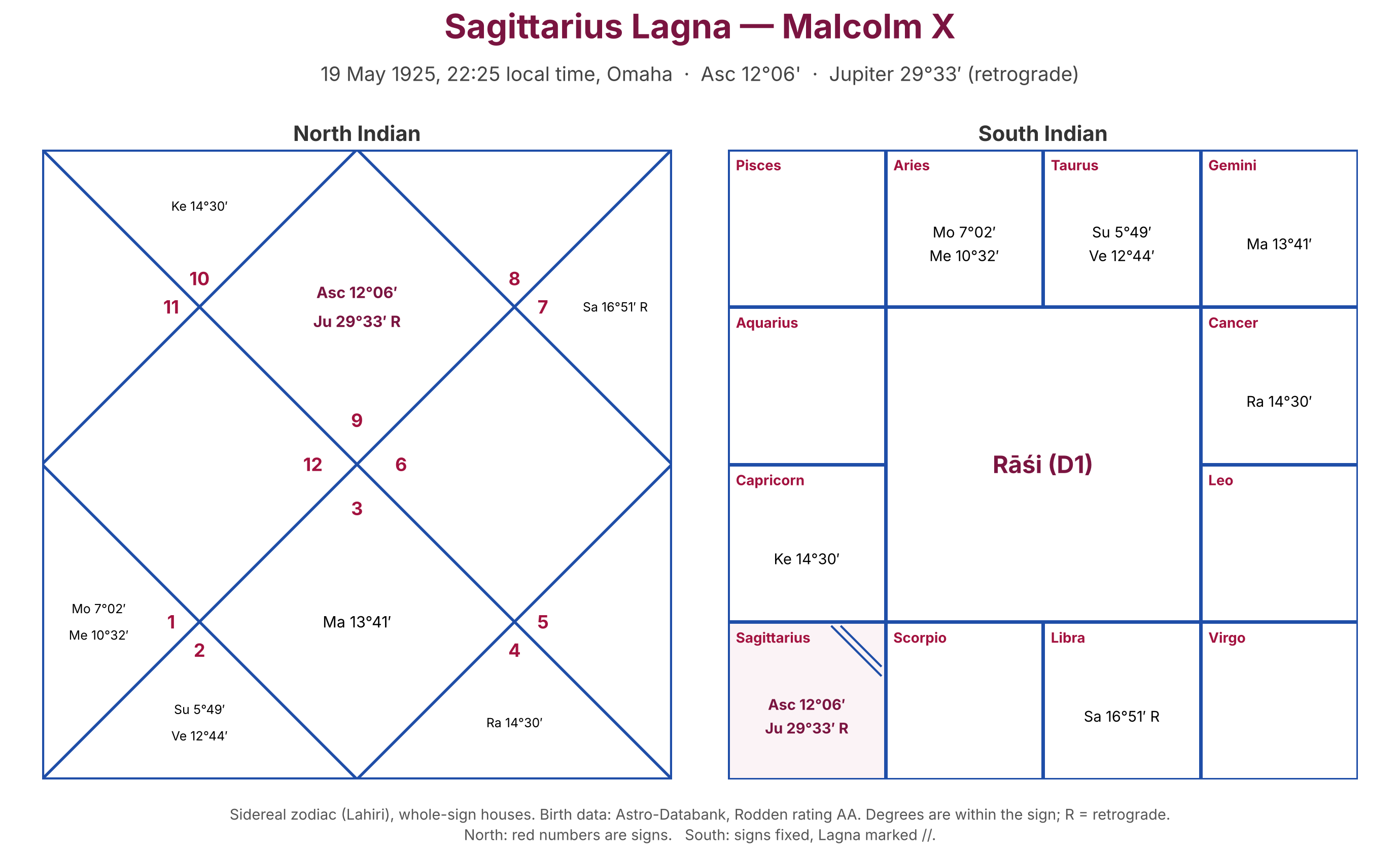
Planetary positions (sidereal, Lahiri ayanāṃśa; houses counted whole-sign from the Lagna; R = retrograde; true nodes):
| Graha | Sign | Degree | Nakṣatra (pada) | House |
|---|---|---|---|---|
| Lagna | Sagittarius (Dhanu) | 12°06′ | Mūla 4 | 1 |
| Sun (Sūrya) | Taurus (Vṛṣabha) | 5°49′ | Kṛttikā 3 | 6 |
| Moon (Candra) | Aries (Meṣa) | 7°02′ | Aśvinī 3 | 5 |
| Mars (Maṅgala) | Gemini (Mithuna) | 13°41′ | Ārdrā 3 | 7 |
| Mercury (Budha) | Aries (Meṣa) | 10°32′ | Aśvinī 4 | 5 |
| Jupiter (Guru) | Sagittarius (Dhanu) | 29°33′ R | Uttara Āṣāḍhā 1 | 1 |
| Venus (Śukra) | Taurus (Vṛṣabha) | 12°44′ | Rohiṇī 1 | 6 |
| Saturn (Śani) | Libra (Tulā) | 16°51′ R | Svātī 4 | 11 |
| Rāhu | Cancer (Karka) | 14°30′ | Puṣya 4 | 8 |
| Ketu | Capricorn (Makara) | 14°30′ | Śravaṇa 2 | 2 |
| Jupiter | Dignity | Compound relation | Dig bala | Gap | Avasthā | Navāṃśa |
|---|---|---|---|---|---|---|
| Sagittarius 29°33′ R, Uttarāṣāḍhā | Own sign (not mūlatrikoṇa) | — | 54.2 | 17.5° | Mṛta (dead) | Sagittarius: vargottama |
This chart shows why the checklist matters. Jupiter is the Lagna lord in his own sign, retrograde and vargottama, and Haṃsa yoga is formally present. But he stands in the last half-degree of the sign, in the mṛta (dead) avasthā, 17.5° from the rising degree, and he receives the aspects of both Mars (from Gemini) and Saturn (from Libra). Malcolm X's life was a Sagittarian story of conversion and conviction: a self-taught education in prison, a powerful ministry, a pilgrimage to Mecca that changed his views. It was also cut short by assassination at thirty-nine. A Jupiter of great dharmic force, besieged by malefics and with little "life" left in his degree, is one honest way to describe it. That is a description, not a mechanical prediction: no single factor here "causes" a short life.
10. Capricorn (Makara): Jupiter debilitated
Dignity. Jupiter's debilitation sign, deepest at 5°: by Bṛhajjātaka 20.11 the good result is "nil", unless the debilitation is cancelled. Vaidyanātha's verse (Jātaka Pārijāta 2.65) insists that Jupiter keeps strength nīca-bhavane'pi, even here.
लघुवीर्यो मकरस्थे बहुश्रमक्लेशधारको जीवे ।
नीचाचारो मूर्खो दुरन्तनिःस्वः परप्रेष्यः ॥१९॥
माङ्गल्यदयाशौचस्वबन्धुवात्सल्यधर्मपरिहीनः ।
दुर्बलदेहो भीरुः प्रवासशीलो विषादी च ॥२०॥laghu-vīryo makarasthe bahu-śrama-kleśa-dhārako jīve / nīcācāro mūrkho duranta-niḥsvaḥ para-preṣyaḥ // māṅgalya-dayā-śauca-sva-bandhu-vātsalya-dharma-parihīnaḥ / durbala-deho bhīruḥ pravāsa-śīlo viṣādī ca
Sārāvalī 27.19–20 · Kalyāṇavarmā · Sanskrit text and numbering: R. Santhanam (ed. & tr.), vol. II, Ranjan Publications · English: author’s translation
What Kalyāṇavarmā says (Sārāvalī 27.19–20). The harshest verse in the chapter: little virility, much grief and hardship, mean conduct, dullness, a bad end, poverty, servitude; without auspiciousness, mercy, purity, affection for relatives or religion; an emaciated body; timid; living abroad; depressed in spirit. But Santhanam's note for Capricorn rising is decisive: "If Jupiter has Neechabhanga, the native will become very famous and rich."
Lordships: 3rd and 12th. The 3rd lord in the Lagna (24.25): "earns by his own arms; bold; intelligent even without formal learning". The 12th lord (24.133): "a spender; weak; without wealth or learning". On paper, the weakest Jupiter of the twelve.
Suryanarain Rao's note quoted under Cancer above gives the plain verdict on Jupiter rising in Capricorn: "ordinary and mean-minded". That is what the sign alone predicts.
Reading. Capricorn bends Jupiter's idealism to Saturn's realism. The person's faith is practical, disciplined, institutional; their wisdom is pragmatic. Everything depends on whether the debilitation is cancelled:
नीचस्थितो जन्मनि यो ग्रहः स्यात् तद्राशिनाथोऽपि तदुच्चनाथः ।
स चन्द्रलग्नाद्यदि केन्द्रवर्ती राजा भवेद्धार्मिकचक्रवर्ती ॥nīca-sthito janmani yo grahaḥ syāt tad-rāśi-nātho'pi tad-ucca-nāthaḥ / sa candra-lagnād yadi kendra-vartī rājā bhaved dhārmika-cakravartī
Phaladīpikā 7.26 · Mantreśvara · Sanskrit text: sanskritdocuments.org · English: author’s translation
"If, for a graha debilitated at birth, the lord of that sign or the lord of its exaltation sign is in a kendra from the Moon or the Lagna, the native becomes a king, a righteous emperor."
Example: Barack Obama. 4 August 1961, 19:24 AHST, Honolulu (Rodden AA).
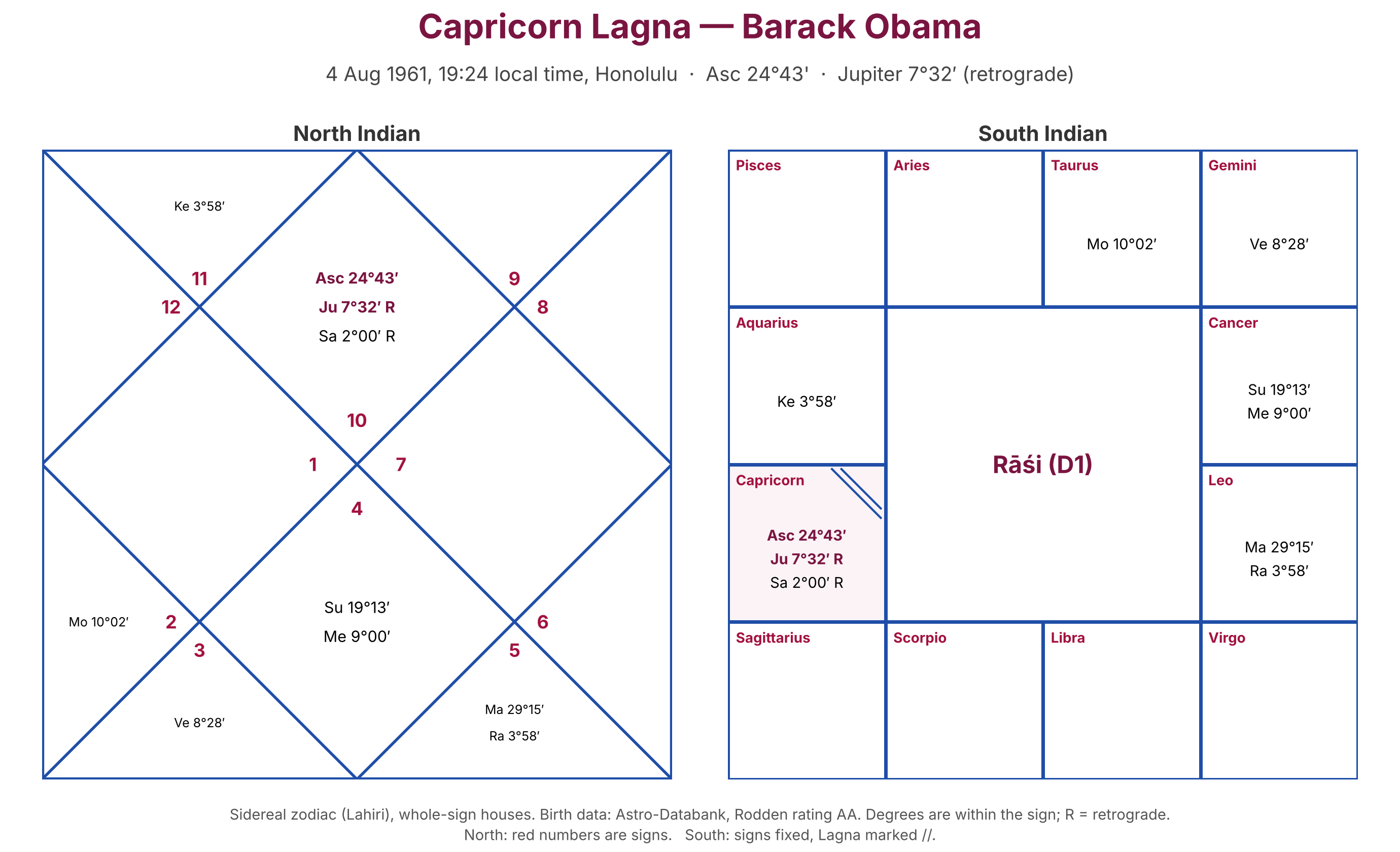
Planetary positions (sidereal, Lahiri ayanāṃśa; houses counted whole-sign from the Lagna; R = retrograde; true nodes):
| Graha | Sign | Degree | Nakṣatra (pada) | House |
|---|---|---|---|---|
| Lagna | Capricorn (Makara) | 24°43′ | Dhaniṣṭhā 1 | 1 |
| Sun (Sūrya) | Cancer (Karka) | 19°13′ | Āśleṣā 1 | 7 |
| Moon (Candra) | Taurus (Vṛṣabha) | 10°02′ | Rohiṇī 1 | 5 |
| Mars (Maṅgala) | Leo (Siṃha) | 29°15′ | Uttara Phalgunī 1 | 8 |
| Mercury (Budha) | Cancer (Karka) | 9°00′ | Puṣya 2 | 7 |
| Jupiter (Guru) | Capricorn (Makara) | 7°32′ R | Uttara Āṣāḍhā 4 | 1 |
| Venus (Śukra) | Gemini (Mithuna) | 8°28′ | Ārdrā 1 | 6 |
| Saturn (Śani) | Capricorn (Makara) | 2°00′ R | Uttara Āṣāḍhā 2 | 1 |
| Rāhu | Leo (Siṃha) | 3°58′ | Maghā 2 | 8 |
| Ketu | Aquarius (Kumbha) | 3°58′ | Dhaniṣṭhā 4 | 2 |
| Jupiter | Dignity | Compound relation | Dig bala | Gap | Avasthā | Navāṃśa |
|---|---|---|---|---|---|---|
| Capricorn 7°32′ R, Uttarāṣāḍhā | Debilitated (2.5° from the deepest point) | — | 54.3 | 17.2° | Vṛddha (old) | Pisces: own sign |
In Kalyāṇavarmā's scheme a debilitated graha is bhīta, frightened (Sārāvalī 5.4), and Santhanam notes that its bad results are strongest when the graha rules the chart and has no cancellation of debilitation. Every rescue the texts offer is present here:
- Nīca-bhaṅga. Saturn, the lord of Capricorn, sits in the Lagna with Jupiter, in his own sign, in a kendra from the Lagna. Phaladīpikā 7.26 is fulfilled.
- Retrogression. Jupiter is retrograde. Phaladīpikā 4.4 counts a retrograde graha strong even in debilitation, and Phaladīpikā 7.3 says such a graha, though debilitated, "makes one equal to a king". The view recorded with Sārāvalī 5.14, and followed in my tradition, is that a debilitated retrograde graha gives results closer to exaltation.
- Navāṃśa. Jupiter is in his own sign, Pisces, in the D9.
Obama, a constitutional-law lecturer who became President of the United States, has a famously measured, professorial, deliberate public persona: Jupiter's teaching voice disciplined by Saturn's restraint. A textbook demonstration that a "debilitated" Jupiter in the Lagna must never be read from the sign alone.
11. Aquarius (Kumbha): Jupiter in Saturn's air
Dignity. Saturn is neutral to Jupiter: a neutral sign. But Vaidyanātha names Aquarius specifically as a sign where Jupiter is strong (kumbhe ca ... balī surejyaḥ, Jātaka Pārijāta 2.65). Aquarius is fixed, airy, humanitarian and austere.
पिशुनो न साधुशीलः कुशिल्पतोयाश्रमेषु कर्मरतः ।
मुख्यो गणस्य सुतरां नीचाभिरतो नृशंसश्च ॥२१॥
लुब्धो व्याधिग्रस्तः स्ववाक्यदोषेण नाशितार्थश्च ।
प्रज्ञादिगुणैर्हीनो घटे गुरौ स्याद्गुरुस्त्रीगः ॥२२॥piśuno na sādhu-śīlaḥ kuśilpa-toyāśrameṣu karma-rataḥ / mukhyo gaṇasya sutarāṃ nīcābhirato nṛśaṃsaś ca // lubdho vyādhi-grastaḥ sva-vākya-doṣeṇa nāśitārthaś ca / prajñādi-guṇair hīno ghaṭe gurau syād guru-strīgaḥ
Sārāvalī 27.21–22 · Kalyāṇavarmā · Sanskrit text and numbering: R. Santhanam (ed. & tr.), vol. II, Ranjan Publications · English: author’s translation
What Kalyāṇavarmā says (Sārāvalī 27.21–22). Surprisingly harsh: a tale-bearer, ill-disposed, drawn to bad work, chief among his own people but attached to low company, malicious, miserly, sickly, losing wealth through his own words, lacking intelligence and virtue. Santhanam points out the conflict: Varāhamihira and Guṇākara say Jupiter in Aquarius is as benefic as in Cancer, and Vaidyanātha (Jātaka Pārijāta 2.65, above) counts Aquarius a sign of strength. The authorities genuinely disagree here, and the example below is worth weighing against both views.
Lordships: 2nd and 11th. The 2nd lord in the Lagna (24.13): "has children and wealth ..."; the 11th lord (24.121): "sāttvic, wealthy, happy, impartial, a poet and eloquent, always gaining". Both are houses of wealth, but for Jupiter in Saturn's sign they often become wealth of learning and of institution.
Reading. The Aquarius Jupiter is the scholar of the collective: theology, philosophy, law or science placed at the service of a community or institution. The personality is often reserved and principled rather than warm, with Saturn's seriousness under Jupiter's dignity.
Example: Pope Benedict XVI (Joseph Ratzinger). 16 April 1927, 04:15 MET, Marktl am Inn, Germany (Rodden AA).
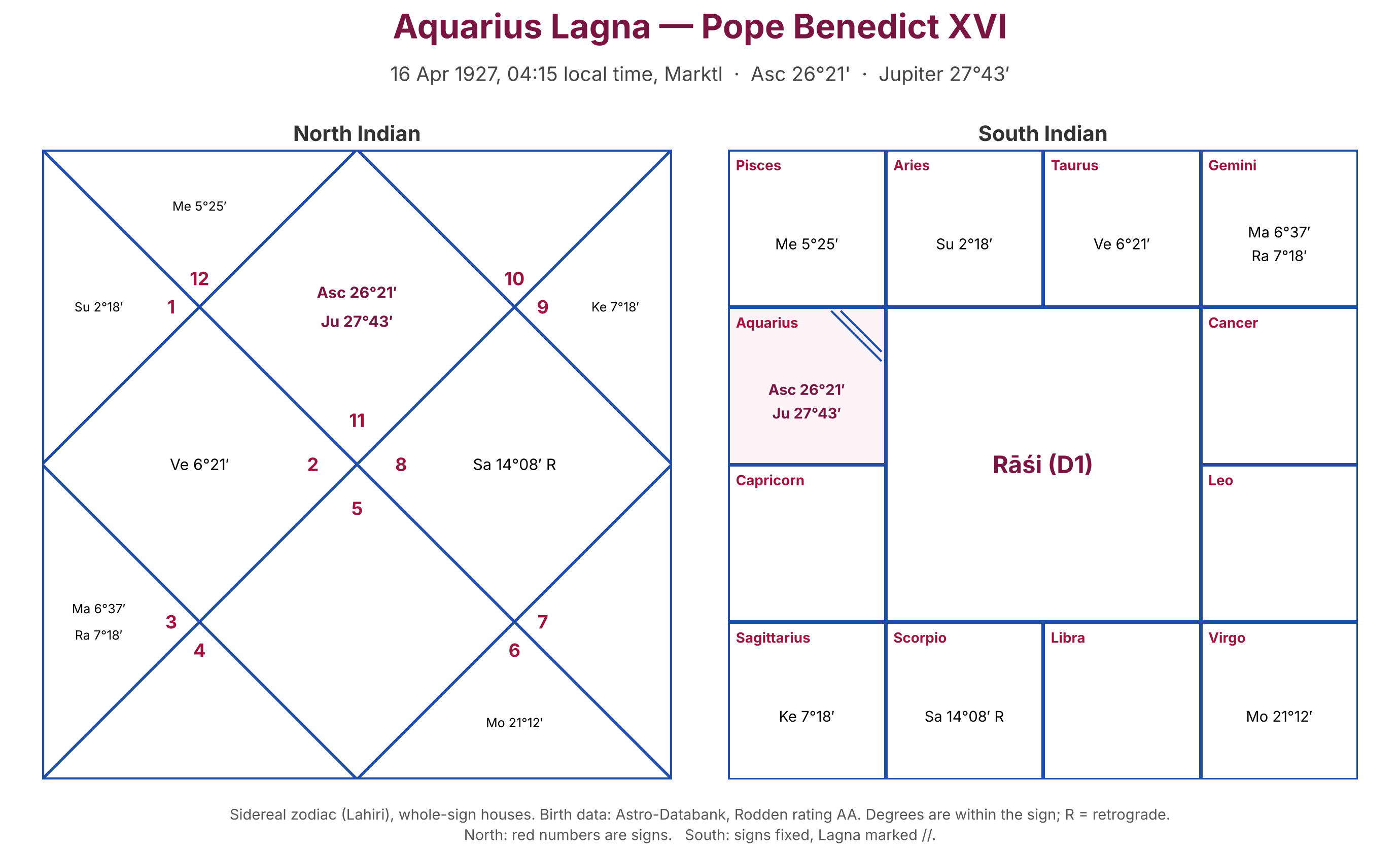
Planetary positions (sidereal, Lahiri ayanāṃśa; houses counted whole-sign from the Lagna; R = retrograde; true nodes):
| Graha | Sign | Degree | Nakṣatra (pada) | House |
|---|---|---|---|---|
| Lagna | Aquarius (Kumbha) | 26°21′ | Pūrva Bhādrapadā 2 | 1 |
| Sun (Sūrya) | Aries (Meṣa) | 2°18′ | Aśvinī 1 | 3 |
| Moon (Candra) | Virgo (Kanyā) | 21°12′ | Hasta 4 | 8 |
| Mars (Maṅgala) | Gemini (Mithuna) | 6°37′ | Mṛgaśirā 4 | 5 |
| Mercury (Budha) | Pisces (Mīna) | 5°25′ | Uttara Bhādrapadā 1 | 2 |
| Jupiter (Guru) | Aquarius (Kumbha) | 27°43′ | Pūrva Bhādrapadā 3 | 1 |
| Venus (Śukra) | Taurus (Vṛṣabha) | 6°21′ | Kṛttikā 3 | 4 |
| Saturn (Śani) | Scorpio (Vṛścika) | 14°08′ R | Anurādhā 4 | 10 |
| Rāhu | Gemini (Mithuna) | 7°18′ | Ārdrā 1 | 5 |
| Ketu | Sagittarius (Dhanu) | 7°18′ | Mūla 3 | 11 |
| Jupiter | Dignity | Compound relation | Dig bala | Gap | Avasthā | Navāṃśa |
|---|---|---|---|---|---|---|
| Aquarius 27°43′, Pūrva Bhādrapadā | Neutral sign | Saturn in Scorpio, 10th from Jupiter: friend | 59.5 | 1.4° | Mṛta (dead) | Gemini (enemy's sign) |
Jupiter is within 1.4° of the rising degree, with near-full dig bala, in a sign Vaidyanātha calls strong for him, in a nakṣatra (Pūrva Bhādrapadā) ruled by Jupiter himself, and with his dispositor Saturn as a compound friend. Against this: the mṛta avasthā and an enemy's navāṃśa. This chart is a fair test of the disagreement noted above. Kalyāṇavarmā's harsh Aquarius verse does not describe this life; Varāhamihira's and Vaidyanātha's view, that Jupiter is strong in Aquarius, fits it far better. Joseph Ratzinger was a professor of theology and one of the Church's foremost theologians before he became Pope, a striking fit for BPHS 33.88's "knower of everything, author of books, master of words". In 2013 he became the first Pope in nearly six centuries to resign. A Jupiter that is exact on the Lagna but "old" or "dead" in degree is worth comparing with Brahms's below.
12. Pisces (Mīna): Jupiter at home in water
Dignity. Jupiter's own sign: half the full result by Bṛhajjātaka 20.11. Haṃsa yoga forms if he is strong (BPHS 75.1).
वेदार्थशास्त्रवेत्ता सुहृदां पूज्यः सतां च नृपनेता ।
श्लाघ्यः सधनोऽधृष्यो ह्यहीनदर्पस्थिरारम्भः ॥२३॥
राज्ञः सुनीतिशिक्षाव्यवहाररणप्रयोगवेत्ता च ।
ख्यातः प्रशान्तचेष्टो मीनयुगे भवति ना जीवे ॥२४॥vedārtha-śāstra-vettā suhṛdāṃ pūjyaḥ satāṃ ca nṛpanetā / ślāghyaḥ sadhano'dhṛṣyo hy ahīna-darpa-sthirārambhaḥ // rājñaḥ sunīti-śikṣā-vyavahāra-raṇa-prayoga-vettā ca / khyātaḥ praśānta-ceṣṭo mīnayuge bhavati nā jīve
Sārāvalī 27.23–24 · Kalyāṇavarmā · Sanskrit text and numbering: R. Santhanam (ed. & tr.), vol. II, Ranjan Publications · English: author’s translation
What Kalyāṇavarmā says (Sārāvalī 27.23–24). Expert in the meaning of the Vedas and śāstras; honoured by friends and the virtuous; a leader in royal service; praiseworthy, unconquerable, rich, fearless and proud; firm in undertakings; skilled in policy, discipline, conduct and strategy; famous, and calm in all he does. Santhanam adds that these results are somewhat less than for Sagittarius, Jupiter's mūlatrikoṇa, and much reduced in the 7th (debilitation) navāṃśa of Pisces.
Lordships: 1st and 10th. The Lagna lord in the Lagna (24.1) and the 10th lord in the Lagna (24.109): "learned, famous, wealthy, a poet; sickly in childhood, happy later, with wealth growing day by day".
Reading. In Pisces, Jupiter's wisdom is devotional, imaginative and boundless: the mystic, the musician, the compassionate teacher. The Lagna lord and 10th lord together on the Lagna make the person's work an expression of their inner life.
Example: Johannes Brahms. 7 May 1833, 03:30 local mean time, Hamburg (Rodden AA).
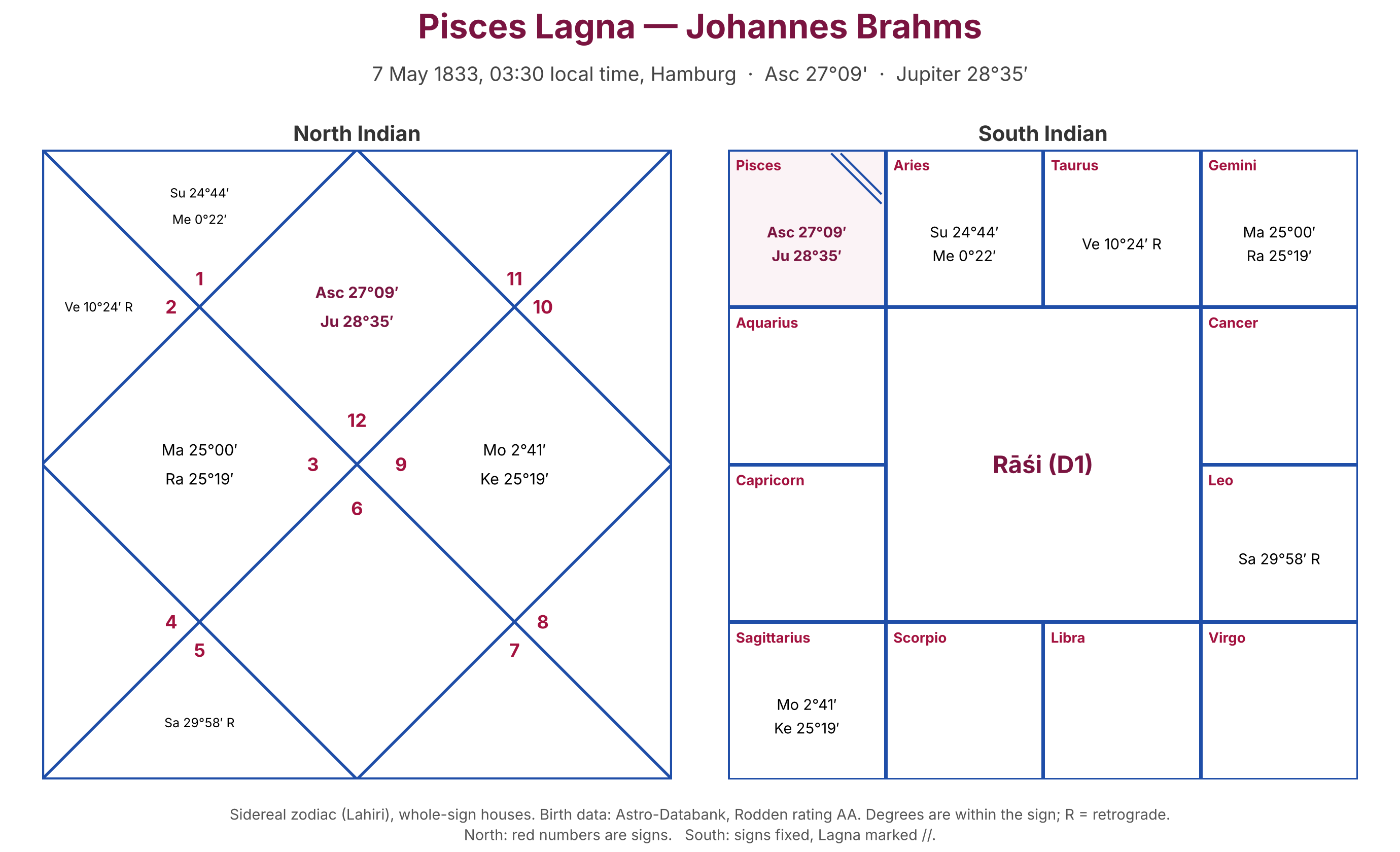
Planetary positions (sidereal, Lahiri ayanāṃśa; houses counted whole-sign from the Lagna; R = retrograde; true nodes):
| Graha | Sign | Degree | Nakṣatra (pada) | House |
|---|---|---|---|---|
| Lagna | Pisces (Mīna) | 27°09′ | Revatī 4 | 1 |
| Sun (Sūrya) | Aries (Meṣa) | 24°44′ | Bharaṇī 4 | 2 |
| Moon (Candra) | Sagittarius (Dhanu) | 2°41′ | Mūla 1 | 10 |
| Mars (Maṅgala) | Gemini (Mithuna) | 25°00′ | Punarvasu 2 | 4 |
| Mercury (Budha) | Aries (Meṣa) | 0°22′ | Aśvinī 1 | 2 |
| Jupiter (Guru) | Pisces (Mīna) | 28°35′ | Revatī 4 | 1 |
| Venus (Śukra) | Taurus (Vṛṣabha) | 10°24′ R | Rohiṇī 1 | 3 |
| Saturn (Śani) | Leo (Siṃha) | 29°58′ R | Uttara Phalgunī 1 | 6 |
| Rāhu | Gemini (Mithuna) | 25°19′ | Punarvasu 2 | 4 |
| Ketu | Sagittarius (Dhanu) | 25°19′ | Pūrva Āṣāḍhā 4 | 10 |
| Jupiter | Dignity | Compound relation | Dig bala | Gap | Avasthā | Navāṃśa |
|---|---|---|---|---|---|---|
| Pisces 28°35′, Revatī | Own sign | — | 59.5 | 1.4° | Bāla (infant) | Pisces: vargottama |
Jupiter is in his own sign, vargottama, 1.4° from the rising degree, with near-full dig bala and Haṃsa yoga. His one flaw is position: at 28°35′ Pisces he stands in gaṇḍānta (Jātaka Pārijāta 1.22), and in the infant (bāla) avasthā. Parāśara's verse for the 10th lord in the Lagna, bālye rogī sukhī paścād dhana-vṛddhir dine dine, "troubled in childhood, happy later, with wealth growing day by day", reads almost as a biography. Brahms grew up poor in Hamburg (he is said to have played piano in the city's taverns as a boy to help his family) and became one of the most revered and financially secure composers of his century. Brahms and Benedict XVI make a good pair to compare. Both have Jupiter exact on the Lagna degree with full dig bala, both in the last degrees of their sign; Brahms's is vargottama in his own sign, Benedict's is in a neutral sign with an enemy's navāṃśa.
The twelve Jupiters compared
| Lagna | Example | Jupiter | Dignity | Ucca bala | Dig bala | Gap | Avasthā | Motion / light | Navāṃśa | Overall |
|---|---|---|---|---|---|---|---|---|---|---|
| Aries | M. L. King Jr. | 8°18′ | Friend (great friend) | 31.1 | 55.8 | 12.6° | Kumāra | — | Enemy | Good |
| Taurus | Greta Garbo | 13°53′ | Enemy (neutral) | 43.0 | 59.6 | 1.1° | Yuvā | — | Vargottama | Strong despite sign |
| Gemini | Hannah Arendt | 18°08′ | Enemy (great enemy) | 54.4 | 59.4 | 1.8° | Vṛddha | — | Own | Rescued by D9 |
| Cancer | Sri Aurobindo | 21°35′ | Exalted | 54.5 | 57.7 | 6.9° | Kumāra | Combust | Debilitated | Mixed |
| Leo | Rajiv Gandhi | 12°12′ | Friend (neutral) | 47.6 | 59.1 | 2.8° | Yuvā | Combust | Exalted | Mixed |
| Virgo | Shirley MacLaine | 23°22′ | Enemy (great enemy) | 33.9 | 54.3 | 17.1° | Kumāra | Retrograde | Friend | Moderate, exchange |
| Libra | Padre Pio | 4°53′ | Enemy (great enemy) | 30.0 | 55.9 | 12.3° | Bāla | Retrograde | Friend | Weak by sign, raised by motion |
| Scorpio | H. C. Andersen | 15°01′ | Friend (neutral) | 16.7 | 56.0 | 11.9° | Yuvā | Retrograde | Vargottama | Strong |
| Sagittarius | Malcolm X | 29°33′ | Own | 1.8 | 54.2 | 17.5° | Mṛta | Retrograde | Vargottama | Powerful but besieged |
| Capricorn | Barack Obama | 7°32′ | Debilitated, cancelled | 0.8 | 54.3 | 17.2° | Vṛddha | Retrograde | Own | Strong (nīca-bhaṅga) |
| Aquarius | Benedict XVI | 27°43′ | Neutral (friend) | 17.6 | 59.5 | 1.4° | Mṛta | — | Enemy | Exact but "old" |
| Pisces | Johannes Brahms | 28°35′ | Own | 27.9 | 59.5 | 1.4° | Bāla | — | Vargottama | Strong, gaṇḍānta |
Ucca bala is Jupiter's distance from his deepest debilitation point (5° Capricorn), divided by three: 60 at exact exaltation, 0 at exact debilitation.
What the examples teach
- Sign dignity is only the first word. The two textbook-best placements, Cancer (exalted) and Leo (friend's sign, five grahas in the Lagna), are both compromised by combustion. The textbook-worst, Capricorn, produced a head of state, because the debilitation is cancelled three ways.
- Retrogression repeatedly rescues Jupiter in weak signs. Virgo, Libra and Capricorn all have retrograde Jupiters, and in each Jupiter delivered far more than his sign alone would suggest, as Phaladīpikā 4.4 predicts.
- The navāṃśa decides close cases. Arendt (own sign in D9), Obama (own sign in D9) and Rajiv Gandhi (exalted in D9) all show Jupiter recovering in the navāṃśa what he lacked in the rāśi; Aurobindo shows the reverse.
- Closeness to the rising degree matters. The four Jupiters within 2° of the Lagna (Garbo, Arendt, Benedict XVI, Brahms) belong to people whose public identity was fused with a single, recognisable gift: a face, a mind, a theology, a body of music. That is suggestive, not proof.
- Parāśara's lordship verses are surprisingly specific. "Sickly but famous" (Padre Pio, 6th lord), "learned and famous" (Arendt, 10th lord), "troubled in childhood, happy later" (Brahms, 10th lord) and the 8th lord's withdrawal (Garbo) are not generic Jupiter results. They come from the house Jupiter rules, not from Jupiter himself.
Further research needed
This is a study, not a proof. Twelve charts, one per sign, cannot establish any rule, and famous lives are known mainly from public reports. The readings above are illustrations of how the classical principles combine, not tests of them. Two of the charts need special caution: Sri Aurobindo's data is rated B and his Lagna is near the end of Cancer, and Martin Luther King Jr.'s is rated A (from memory) rather than AA. A full study would compute complete ṣaḍbala for each chart, add the daśās (when did Jupiter's own periods coincide with the defining events?), and compare many more charts for each sign. Readers with well-timed charts that have Jupiter in the Lagna are warmly invited to share them.
Sources
- Bṛhajjātaka of Varāhamihira: 1.19 (strength of the Lagna), 1.13–14 (exaltation and mūlatrikoṇa), 2.1 and 2.10 (Jupiter's significations and form), 19.9 (navāṃśa), 20.7 (Jupiter in the twelve houses), 20.10–11 (dignity and results). Devanagari text: sanskritdocuments.org.
- Sārāvalī of Kalyāṇavarmā, translated by R. Santhanam, vol. I (Ranjan Publications, 1983): 4.25 (Jupiter's form), 4.34–35 (strength; dig bala), 5.2–14 (the nine avasthās and their results; retrogression in exaltation), 5.18 (Jupiter in a kendra); and vol. II: 27.1–24 (Jupiter in the twelve signs, summarised from Santhanam's translation, with his notes), 30.50 (Jupiter in the Lagna, with Santhanam's notes citing Garga and Bhṛgu).
- Sarvārtha Cintāmaṇi of Veṅkaṭeśa Daivajña, with English translation and notes by B. Suryanarain Rao (1899; his name is spelled "Row" on the title page): chapter 2, stanzas 224–226 (Jupiter in the Lagna and stoutness), 236 (Jupiter strong in a kendra; happiness from childhood) and 246 (Lagna lord and Jupiter in kendras; long life). Stanza numbers follow Rao's edition. The result for combustion is cited from Santhanam's summary of Sarvārtha Cintāmaṇi, chapter 13, in his notes to Sārāvalī 5.13.
- Phaladīpikā of Mantreśvara: 2.12 (Jupiter's form), 4.2, 4.4, 4.7 and 4.11 (strength), 7.3 and 7.26 (retrograde and debilitated grahas; nīca-bhaṅga), 8.14 and 8.35 (Jupiter in the Lagna; degree of the bhāva). Devanagari text: sanskritdocuments.org; English: V. Subrahmanya Sastri (1950).
- Bṛhat Parāśara Horā Śāstra: 24 (lords of the houses in the Lagna), 27.7–8 and 27.21 (dig bala; the eight motions), 33.85–88 (Jupiter in the kārakāṃśa), 34.2–4 and 34.10 (kendrādhipatya doṣa; malefic lordships), 75.1–2 and 75.13 (Haṃsa yoga). Verse numbers follow the sanskritdocuments.org edition, whose chapter numbers match Santhanam's; verse numbers may differ slightly in other editions.
- Jātaka Pārijāta of Vaidyanātha Dīkṣita: 1.22 (gaṇḍānta), 2.35 (dig bala), 2.57 (Jupiter's form), 2.65 (where Jupiter is strong), 2.84 (bālādi avasthā). Devanagari text: sanskritdocuments.org.
- Jaimini, Upadeśa Sūtras 1.2, on grahas in the kārakāṃśa, cited through the parallel BPHS chapter 33.
- Sūrya Siddhānta: cited only for the astronomical basis of planetary positions and motion; it gives no house results.
- The sign-by-sign readings are derived by the author from the classical principles above; they are not quoted from any single text.
- Birth data: Astro-Databank (astro.com), with Rodden ratings as shown. Charts calculated by the author with the Swiss Ephemeris, Lahiri ayanāṃśa, whole-sign houses.
Thoughts? Leave a Comment