Marriage Compatibility in Jyotiṣa: Seven Points Beyond the Guṇa Score
Why the guṇa score is only the beginning
Most families in India begin, and too often end, marriage matching with a single number: the Aṣṭakūṭa guṇa score out of 36. Eighteen or more and the match is "approved"; below that, it is "rejected". The number is useful. It compares the two Moons and their nakṣatras, and so it tells us something real about the emotional and instinctive fit between two people.
But the Moon is only one of the nine grahas, and the nakṣatra is only one layer of the chart. The classical tradition, from Parāśara to Jaimini, asks much more of a match. It asks how the two Lagnas relate, where each person's 7th lord falls in the other's chart, what condition the marriage kārakas Venus and Jupiter are in, what the Navāṁśa promises, how durable the Upapada Lagna is, and which daśās the couple will live through together.
In this article I walk through seven points I use in practice. To keep it concrete, I apply every point to one real couple, a man and his wife who were married for about twenty-five years before separating. Their names and birth details are withheld; I call them Man A and Wife B. Looking back at a long marriage is a fair test of a method, because we can see which indications held true.
The example couple: Man A and Wife B
Both charts are given below in the North Indian style (houses fixed, Lagna at the top) and the South Indian style (signs fixed, Lagna marked with //). Only the Rāśi (D1) positions are shown; the Navāṁśa is discussed in Point 5.
Man A — Cancer (Karka) Lagna
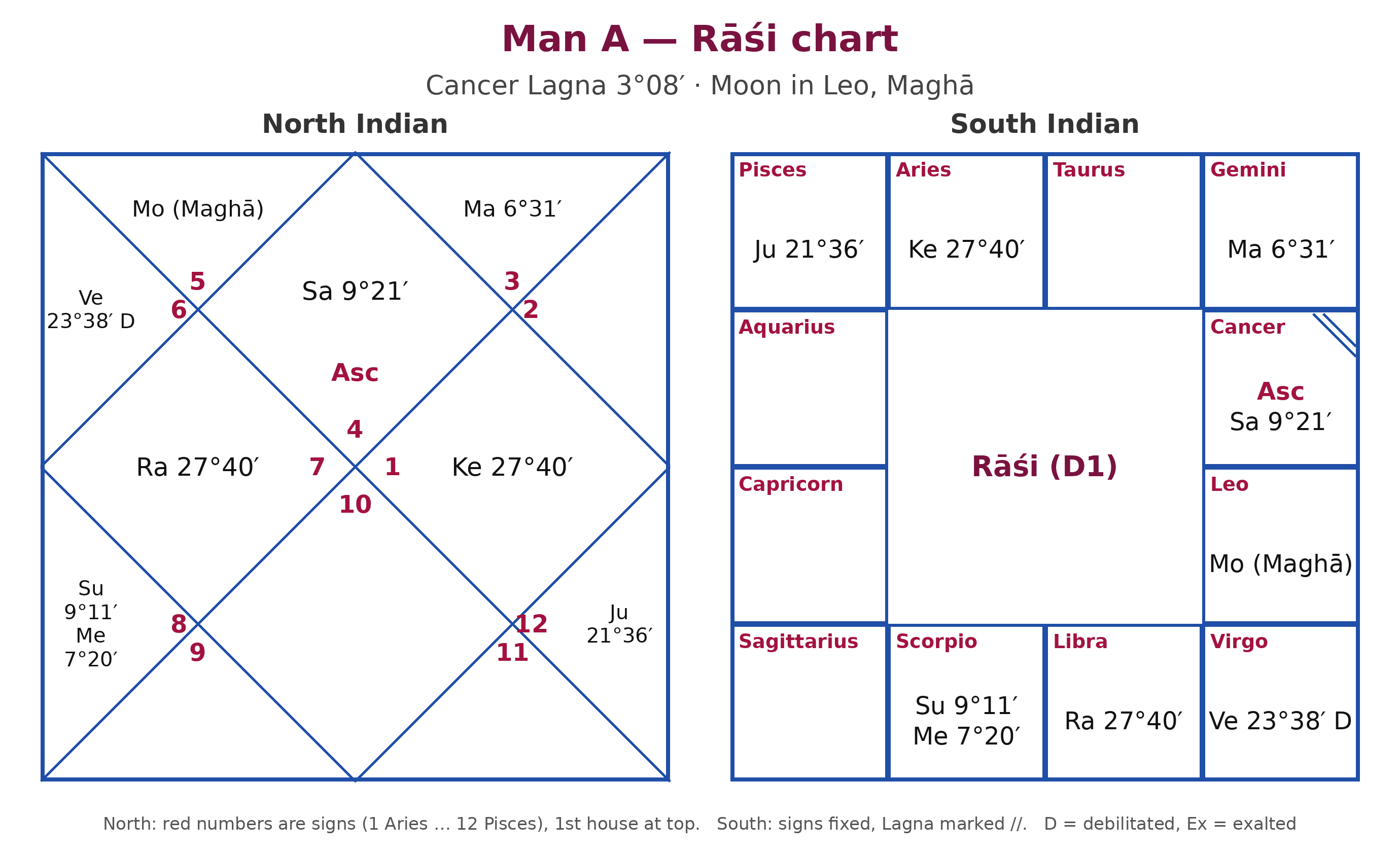
| House | Sign | Grahas |
|---|---|---|
| 1st | Cancer | Lagna 3°08′, Saturn 9°21′ |
| 2nd | Leo | Moon (Maghā) |
| 3rd | Virgo | Venus 23°38′ (debilitated) |
| 4th | Libra | Rāhu 27°40′ |
| 5th | Scorpio | Sun 9°11′, Mercury 7°20′ (combust) |
| 9th | Pisces | Jupiter 21°36′ (own sign, Haṃsa yoga) |
| 10th | Aries | Ketu 27°40′ |
| 12th | Gemini | Mars 6°31′ |
Wife B — Virgo (Kanyā) Lagna
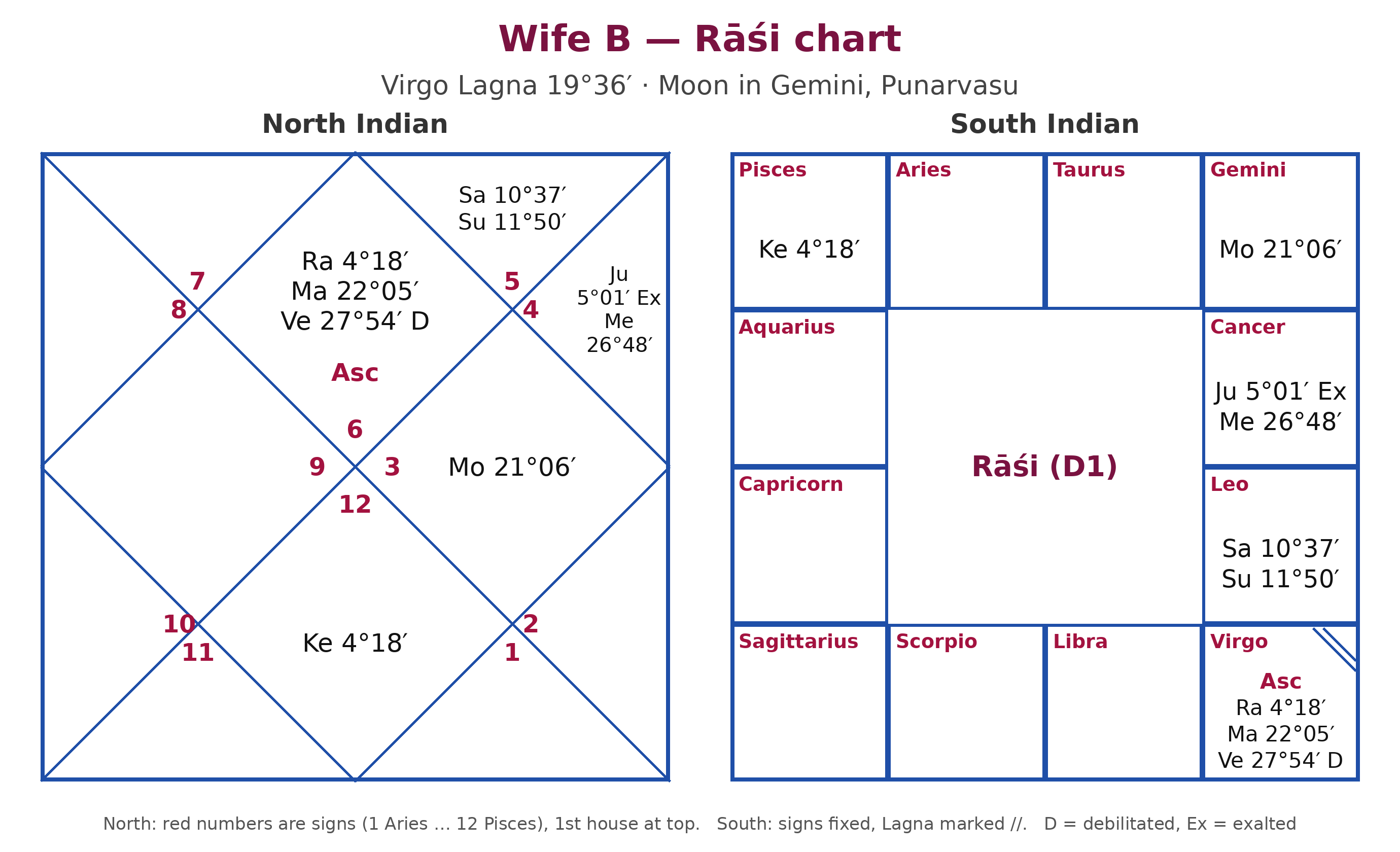
| House | Sign | Grahas |
|---|---|---|
| 1st | Virgo | Lagna 19°36′, Rāhu 4°18′, Mars 22°05′, Venus 27°54′ (debilitated) |
| 7th | Pisces | Ketu 4°18′ |
| 10th | Gemini | Moon 21°06′ (Punarvasu) |
| 11th | Cancer | Jupiter 5°01′ (exalted), Mercury 26°48′ |
| 12th | Leo | Saturn 10°37′, Sun 11°50′ |
Two things stand out at once. Both have Venus debilitated in Virgo, and in both charts Venus is the Ātmakāraka, the highest-degree graha. And Wife B's Lagna, Virgo, is exactly the sign that holds Man A's Venus. We will return to both.
Point 1 — Aṣṭakūṭa guṇa milan
The method
Aṣṭakūṭa compares only the two Moons: the Moon sign (rāśi) and the Moon nakṣatra of each person. Eight tests, or kūṭas, are applied, each worth more points than the last, for a total of 36. Traditionally 18 is the minimum for a match. The rules for each kūṭa are:
| Kūṭa | Max | What it tests | The rule |
|---|---|---|---|
| Varṇa | 1 | Temperament and spiritual inclination | Each sign has a varṇa: Brāhmaṇa (Cancer, Scorpio, Pisces), Kṣatriya (Aries, Leo, Sagittarius), Vaiśya (Taurus, Virgo, Capricorn), Śūdra (Gemini, Libra, Aquarius). 1 point if the man's varṇa is equal to or higher than the woman's, otherwise 0. |
| Vaśya | 2 | Natural attraction and influence | Signs fall into five groups: Catuṣpada (four-footed), Mānava (human: Gemini, Virgo, Libra, Aquarius, first half of Sagittarius), Jalacara (water), Vanacara (wild: Leo) and Kīṭa (Scorpio). Same group 2; one group controls the other 1; otherwise 0. |
| Tārā | 3 | Wellbeing and fortune through the bond | Count from the woman's nakṣatra to the man's, and from his to hers, and divide each count by 9. A remainder of 3 (Vipat), 5 (Pratyari) or 7 (Naidhana) is unlucky. Each lucky direction gives 1.5 points. |
| Yoni | 4 | Instinctive and physical compatibility | Each nakṣatra has an animal yoni. Same animal 4, friendly 3, neutral 2, unfriendly 1, sworn enemies 0. |
| Graha Maitrī | 5 | Mental friendship | Compare the lords of the two Moon signs. Both friends 5; friend and neutral 4; both neutral 3; friend and enemy 1; neutral and enemy 0.5; both enemies 0. |
| Gaṇa | 6 | Basic nature | Each nakṣatra is Deva (gentle), Manuṣya (human) or Rākṣasa (fierce). Same gaṇa 6; Deva with Manuṣya 5 or 6; Manuṣya with Rākṣasa 0; Deva with Rākṣasa 0 (some tables give 1). |
| Bhakūṭa | 7 | Relationship of the Moon signs: health, wealth and harmony | Count from one Moon sign to the other. 2/12, 5/9 and 6/8 are doṣas and score 0; 1/1, 3/11, 4/10 and 7/7 score 7. |
| Nāḍī | 8 | Constitution, health and progeny | Each nakṣatra belongs to Ādi, Madhya or Antya nāḍī. Different nāḍīs 8; the same nāḍī is Nāḍī doṣa, 0. |
Applying it to A and B
Man A's Moon is in Leo, Maghā nakṣatra. Wife B's Moon is in Gemini, Punarvasu nakṣatra.
| Kūṭa | Man A | Wife B | Score | Why |
|---|---|---|---|---|
| Varṇa | Leo: Kṣatriya | Gemini: Śūdra | 1 / 1 | His varṇa is higher than hers, so the full point. |
| Vaśya | Leo: Vanacara (wild) | Gemini: Mānava (human) | 0 / 2 | Different groups, and in the usual table the wild and human groups do not control each other. |
| Tārā | Maghā (10th nakṣatra) | Punarvasu (7th nakṣatra) | 1.5 / 3 | Her nakṣatra to his is 4, remainder 4 (Kṣema), lucky: 1.5. His to hers is 25, remainder 7 (Naidhana), unlucky: 0. |
| Yoni | Maghā: Rat (male) | Punarvasu: Cat (female) | 0 / 4 | Rat and Cat are sworn enemies. |
| Graha Maitrī | Lord: Sun | Lord: Mercury | 4 / 5 | Mercury counts the Sun as a friend; the Sun counts Mercury as neutral. Friend and neutral give 4. |
| Gaṇa | Maghā: Rākṣasa | Punarvasu: Deva | 0 / 6 | The fierce and gentle gaṇas are opposites. |
| Bhakūṭa | Leo | Gemini | 7 / 7 | Gemini to Leo is 3, Leo to Gemini is 11. A 3/11 relationship carries no doṣa. |
| Nāḍī | Maghā: Antya | Punarvasu: Ādi | 8 / 8 | Different nāḍīs, so no Nāḍī doṣa. |
| Total | 21.5 / 36 |
On the usual rule, 21.5 is a pass, and many families would have stopped here. Yet look at where the zeros fall. Yoni and Gaṇa are the two kūṭas that describe instinct and basic nature, and both score nothing. Maghā is a Rākṣasa-gaṇa nakṣatra with the Rat yoni; Punarvasu is Deva-gaṇa with the Cat yoni. In plain words, the two would meet the same situation with very different reflexes, and each could feel the other as a quiet threat.
Lesson: read the guṇa table kūṭa by kūṭa, not as a total. A comfortable score can hide a zero exactly where daily life is lived. (Vaśya values differ slightly between tables; the conclusion does not change.)
Point 2 — Maṅgala doṣa and its cancellation
The method
Mars is heat, will and the urge to fight. In certain houses it presses on the marriage, and this is called Maṅgala (Kuja) doṣa. The rules are:
- The houses. Mars in the 1st, 2nd, 4th, 7th, 8th or 12th house gives the doṣa. These are the self, the family, domestic peace, the spouse, the longevity of the bond and the bed. (Some traditions leave out the 2nd.)
- Three reference points. Count the houses from the Lagna, from the Moon and from Venus. The doṣa from one point is mild; from two or three it is strong.
- Strength of Mars. Mars joined with Rāhu, Saturn or the Sun, or aspecting the 7th house, makes it heavier. Mars in its own sign (Aries, Scorpio) or exaltation (Capricorn), or aspected by Jupiter, makes it lighter. The classics also list sign-based exceptions for each house.
- Cancellation in matching (sāmya). If both charts carry the doṣa, it is said to cancel. If only one does, the other chart should show comparable malefic strength in the same houses.
Applying it to A and B
Man A: Mars is in the 12th from the Lagna, so the doṣa is present from the Lagna. From the Moon (Leo) Mars is in the 11th, and from Venus (Virgo) it is in the 10th, so neither shows it. This is a mild doṣa.
Wife B: Mars is in the Lagna itself, together with Rāhu. It is also in the 4th from the Moon and conjunct Venus. The doṣa is present from all three points, and Mars joined with Rāhu (Aṅgāraka yoga) adds intensity. From the Lagna, Mars aspects the 4th, 7th and 8th houses: the home, the spouse and the bond itself.
By the textbook rule, A and B "cancel" each other. In reality, one partner carries a light 12th-house Mars, and the other carries a strong Mars-Rāhu in the Lagna that colours her whole personality.
Lesson: sāmya is about the presence of the doṣa, not its weight. Grade the strength of Mars in both charts before you call it cancelled.
Point 3 — Lagna, 7th house and 7th lord links
The method
This is the heart of chart-to-chart matching. Place one person's grahas into the other's houses and apply four tests:
- Lagna to Lagna. Count from one Lagna to the other, as in Bhakūṭa. 1/7, 3/11, 4/10 and 5/9 relationships are harmonious; 2/12 and 6/8 are strained.
- Lagna lords. Where does each person's Lagna lord fall in the other's chart? In a kendra (1, 4, 7, 10), a trikona (1, 5, 9) or the 11th it supports; in the 6th, 8th or 12th it strains.
- 7th lords. Where does each person's 7th lord, the planet of the spouse, fall in the other's chart? The strongest link is when it falls on the other's Lagna, Moon or Lagna lord, or when the two 7th lords join.
- The 7th house itself. Note Rāhu, Ketu, Saturn, Mars or the Sun in either 7th house, and any of the other person's benefics that fall there.
Applying it to A and B
The two Lagnas. Cancer and Virgo are 3/11 from each other. Wife B's Lagna is the 3rd from Man A's, the house of effort, courage and companionship; Man A's Lagna is the 11th from hers, the house of gains and fulfilled wishes. This is a friendly, cooperative relationship: two people who can work side by side.
The 7th lords meet. Man A's 7th lord is Saturn, sitting in his own Lagna in Cancer. Wife B's 7th lord is Jupiter, exalted in Cancer. So both 7th lords occupy the same sign, and that sign is Man A's Lagna. Her planet of the husband sits on his very body. This is one of the strongest marriage links one can find, and it explains why the bond formed and lasted as long as it did.
Jupiter in her 7th. Man A's Jupiter is in Pisces in its own sign, forming Haṃsa yoga. Pisces is Wife B's 7th house. The husband brings a Jupiterian, guiding, guru-like quality into her house of marriage. But her 7th house also holds Ketu, the graha of detachment and separation. The same house that received his Jupiter carries a seed of letting go.
The Lagna lords do not mirror each other. Wife B's Lagna lord Mercury is in Cancer, falling in Man A's Lagna: she is drawn to him and identifies with him. Man A's Lagna lord, the Moon, is in Leo, which is Wife B's 12th house, where her Saturn and Sun sit. The 12th is the house of expense, distance and loss. His mind lands in her house of withdrawal, on her Saturn.
Lesson: strong 7th-lord links make a marriage happen and hold it together. To judge how comfortable it will be, also check where each Lagna lord falls, and whether the 7th house carries Rāhu or Ketu.
Point 4 — Venus and Jupiter, the marriage kārakas
The method
Kārakas are natural significators. For marriage, Venus signifies the wife and married happiness, and in a woman's chart Jupiter signifies the husband. In Jaimini's system the Ātmakāraka (the graha at the highest degree) shows the soul's main lesson, and the Dārakāraka (the lowest degree) shows the spouse. Judge each kāraka by:
- Dignity. Exalted or own sign is strong; friendly is good; enemy sign is weak; debilitated is weakest.
- House. Kendras and trikonas support; the 6th, 8th and 12th weaken.
- Company. Conjunction with Rāhu, Ketu, Mars or Saturn afflicts; closeness to the Sun burns (combustion); Jupiter's aspect protects.
- Cancellation of debilitation (nīca bhaṅga). A debilitated graha is rescued if the lord of the sign it occupies, or the lord of its exaltation sign, is in a kendra from the Lagna or the Moon.
A strong spouse-kāraka can hold a marriage together even when the houses are stressed; a weak one makes every other problem heavier.
Applying it to A and B
Man A's Venus is debilitated in Virgo in the 3rd house. It has a partial rescue (nīca bhaṅga): the lord of Virgo, Mercury, sits in Scorpio, a kendra from the Moon. So his experience of marriage begins under strain but can recover with effort.
Wife B's Jupiter is exalted in Cancer in the 11th. The husband-kāraka is strong: the husband she draws is capable, principled and a source of gain. In this sense the marriage gave her a great deal.
Wife B's Venus is a different story. It sits at 27°54′ Virgo, almost at its deepest point of debilitation, in the Lagna with Mars and Rāhu, and no nīca bhaṅga applies. Venus governs her own capacity for contentment, affection and pleasure in the relationship. However good the husband, the inner experience of the marriage is hard for her to enjoy.
A shared Ātmakāraka. In both charts Venus is the Ātmakāraka, the soul's significator in Jaimini's scheme, and in both it is debilitated in the same sign. Both souls came with the same lesson about love, desire and relationship. And because Wife B's Lagna is Virgo, Man A sees his own Venus reflected in her: a deep attraction, and a mirror that can be painful to look into.
Lesson: judge the kāraka of the spouse (Venus for him, Jupiter for her) and each person's own Venus. A strong spouse-kāraka cannot fully compensate for a native's own afflicted Venus.
Point 5 — The Navāṁśa (D9)
The method
The Rāśi chart shows the promise; the Navāṁśa shows the fruit. It is the chart of dharma and of marriage, and a graha's condition in D9 tells us whether what it promised in D1 will actually be enjoyed.
- Casting the D9. Each sign is divided into nine parts of 3°20′. Counting begins from Aries for fire signs, Capricorn for earth signs, Libra for air signs and Cancer for water signs. For example, Venus at 27°54′ Virgo is in the 9th part; counting nine signs from Capricorn gives Virgo.
- Dignity in D9. A graha in the same sign in D1 and D9 (vargottama) is strengthened. A graha debilitated in D9 cannot fully deliver what it promised in D1.
- What to examine. The D9 Lagna and its lord, the D9 7th house and its lord, and Venus and Jupiter in D9. Count how many grahas are debilitated.
- Cross-links. Check where each person's D9 7th lord falls relative to the other's D9 Lagna.
Applying it to A and B
Wife B's Navāṁśa has Gemini rising, and three grahas fall into debilitation:
- Venus is debilitated in Virgo again. Debilitated in both Rāśi and Navāṁśa, it is called dvir-nīca, and it is one of the heaviest afflictions marriage can carry.
- Mars is debilitated in Cancer, with the Sun and Saturn.
- Mercury, her Lagna lord, is debilitated in Pisces.
Man A's Navāṁśa has Leo rising, with Venus, his Ātmakāraka, in the D9 Lagna. The Venus that was debilitated in D1 is no longer debilitated in D9 and sits in the strongest house: for him, the difficulty around love eases with time and maturity. His Jupiter is retrograde in Capricorn, its sign of debilitation, which bears on the wisdom and guidance he brings into the marriage.
The cross-links. Wife B's D9 7th lord, Jupiter, sits in Leo, which is Man A's D9 Lagna: in her marriage chart, the husband-planet lands on him. That is a real karmic tie. But Ketu sits in Leo with that Jupiter, so the tie carries detachment. And Man A's retrograde Jupiter falls in her D9 8th house, a house of sudden change and of what is hidden.
Lesson: a strong D1 link with a broken D9 often gives a marriage that happens and lasts for years, yet is not truly enjoyed. Count the debilitations in each Navāṁśa, and look again at where each D9 7th lord falls.
Point 6 — Upapada Lagna and the durability of marriage
The method
In Jaimini's system the Upapada Lagna (UL) is the ārūḍha, or image, of the 12th house. It shows the marriage as it is lived and seen in the world.
- Finding the UL. Find the lord of the 12th house. Count from the 12th house to the sign where its lord sits, then count the same number again from that sign. The sign reached is the UL. If this lands in the 12th house itself or the 7th from it, take the 10th sign from there instead.
- The 2nd from the UL shows whether the marriage is sustained or broken. Benefics there sustain it; malefics there, especially Rāhu or Ketu, threaten it.
- The UL lord's dignity. A strong UL lord gives a good spouse and marriage; a debilitated one gives difficulty.
- Rāhu and Ketu. Either node on the UL or on the 2nd from it is a classical indication of separation or detachment.
Applying it to A and B
Man A: his 12th house is Gemini, whose lord Mercury sits in Scorpio, six signs away. Six signs from Scorpio is Aries, so the UL is Aries, in his 10th house, and Ketu sits on it. Ketu on the Upapada is a classical indication of detachment from the spouse or a break in the marriage. The 2nd from the UL is Taurus, whose lord Venus is debilitated.
Wife B: her 12th house is Leo, and its lord the Sun sits in Leo itself. The count lands back in the 12th, so by the exception we take the 10th sign from it: Taurus, her 9th house. Its lord is Venus, the same doubly debilitated Venus in her Lagna. The 2nd from her UL is Gemini, holding her Moon, which sustains the marriage for a long time.
Read together: in both charts the marriage is ruled by a debilitated Venus, and in his chart Ketu sits directly on the Upapada. Her Moon in the 2nd from UL explains why the marriage nevertheless held for so many years.
Lesson: the Upapada answers a question the guṇa table never asks: will this marriage endure? Always check Rāhu and Ketu against the UL and the 2nd from it.
Point 7 — Daśā timing
The method
A chart shows what is possible; the daśā shows when it happens. Viṃśottarī daśā begins from the Moon's nakṣatra and runs through nine planetary periods over 120 years.
- Marriage-related periods. Events of marriage, good or bad, tend to come in the mahādaśā or antardaśā of the 7th lord, grahas in or aspecting the 7th house, Venus, the Dārakāraka, the UL lord, and Rāhu or Ketu when they sit on the 1/7 axis or the UL.
- Difficult periods. Daśās of the 6th, 8th and 12th lords, and of afflicted nodes, test the bond.
- Both charts together. Write the two daśā sequences side by side for the next fifteen to twenty years. A hard period in one chart can be carried by the other; when both run hard periods at the same time, the marriage is tested.
Applying it to A and B
The separation of A and B is a clear example.
- Wife B was running Mercury mahādaśā with Jupiter antardaśā. Mercury is her Lagna lord, the self asserting its own direction. Jupiter is her 7th lord, the Dārakāraka in Jaimini's scheme, and the planet of the husband. A daśā combining "self" and "spouse" is exactly when a question about the marriage comes to a head.
- Man A had entered Rāhu mahādaśā only weeks earlier. Rāhu sits in his 4th house, the house of home and domestic peace. And Rāhu's daśā always activates its partner, Ketu, which in his chart sits on the Upapada Lagna.
Two independent daśā signals, one in each chart, arrived at the same moment. This is how classical timing works: an event of the marriage is shown in both charts.
Lesson: when matching, write the two daśā sequences side by side. A difficult period for one partner can be carried by the other; when both run difficult periods together, plan for it.
Putting it together
| Point | Man A and Wife B | Verdict |
|---|---|---|
| 1. Guṇa milan | 21.5 of 36, but zero in Yoni and Gaṇa | Passes on paper; instinctive mismatch |
| 2. Maṅgala doṣa | Present in both, far stronger in B | "Cancelled" in name only |
| 3. Lagna and 7th lords | Both 7th lords in Cancer, A's Lagna | Very strong bond |
| 4. Venus and Jupiter | B's Jupiter exalted; both Venus debilitated | Good spouse, hard to enjoy |
| 5. Navāṁśa | B has three debilitations; A's Venus recovers | Fruit of marriage weak for B |
| 6. Upapada | Ketu on A's UL; both UL lords debilitated Venus | Durability under threat |
| 7. Daśā | Both under marriage-related pressure together | Timing of the crisis |
This is why the marriage happened, why it lasted a quarter of a century, and why it finally broke. The strongest link between the charts is the meeting of the two 7th lords in Cancer, and that alone can hold two people together for many years. The weakest points are Venus, debilitated in both charts and doubly so in Wife B's, and Ketu on Man A's Upapada. A guṇa score of 21.5 saw none of this.
A checklist for your own matching
- Read the guṇa table kūṭa by kūṭa, and take zeros in Yoni, Gaṇa, Bhakūṭa or Nāḍī seriously whatever the total.
- Grade Maṅgala doṣa from Lagna, Moon and Venus before accepting cancellation.
- Place each person's Lagna lord and 7th lord into the other's chart.
- Judge Venus in both charts and the spouse-kāraka (Venus for him, Jupiter for her).
- Compare the Navāṁśas and count debilitations.
- Check the Upapada Lagna and the 2nd from it for Rāhu, Ketu and afflicted lords.
- Lay the two daśā sequences side by side for the next twenty years.
No chart condemns a marriage, and none guarantees one. Astrology shows where the effort will be needed. A couple who know their Venus is weak can choose patience and gentleness; a couple who know a hard daśā is coming can prepare for it together. That, more than any score, is the purpose of matching.
Thoughts? Leave a Comment